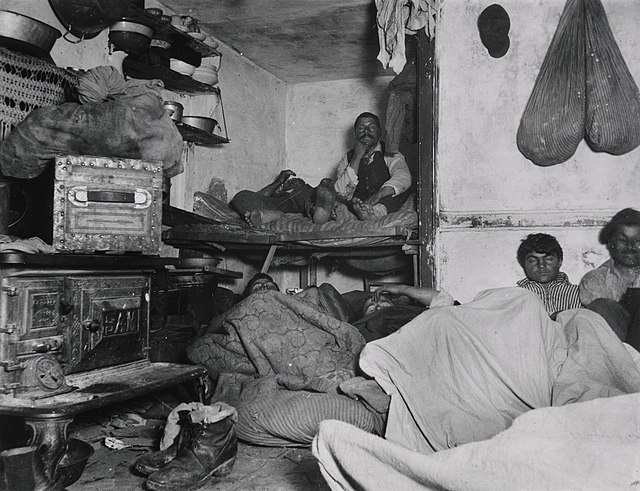
Closing Some Tenement Loopholes

The City of New York caught on to these ‘work arounds’ when the tenement problems continued. The Second Tenement Act of 1879 addressed the 1867 ‘window in every unit’ regulation by requiring that the window must face a source of fresh air, not another room or interior hallway. A further amendment in 1887 stated the toilets had to be placed inside the building. New developments were constructed with air shafts between the buildings to ensure a fresh air source.
Once again, there were loopholes. Nobody said there had to be an access to those air shafts to clean them out, so the garbage stacked up. Additionally, these regulations didn’t always change conditions for existing buildings. Despite the city’s attempts at fixing the problems, loopholes revealed themselves, building violations outnumbered the inspectors, even landlords that wanted to fix the problem sometimes couldn’t afford to do so. Conditions didn’t get much better.