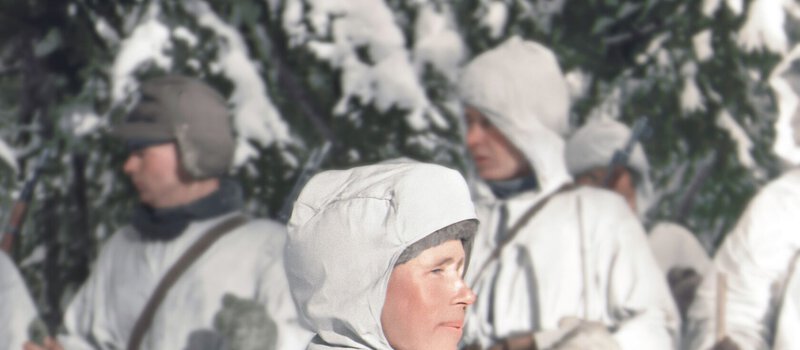
In the winter of 1939-40, a single Finnish sniper nicknamed the White Death accumulated at least 505 confirmed kills in roughly 100 days — a figure that has never been seriously challenged as the highest documented sniper tally in military history.
A Soviet patrol moves through the Finnish forest in December 1939, boots crunching through knee-deep snow, breath rising in small white clouds against air locked at -40°C. Somewhere ahead in the white nothing, a man they cannot see is already watching them — and he has packed snow into his mouth so that even his breath will not give him away.The Man the Snow Was Hiding
That small, deliberate act — snow held in the mouth to suppress the visible steam of a living body — tells you almost everything about Simo Häyhä. Patient. Invisible. Methodical. A man who had thought through every variable that might get him killed and had dealt with each one, quietly, before the shooting started.
He was 34 years old in the winter of 1939, approximately 5’3″ tall, and had grown up on a farm in Rautjärvi, a small municipality in southeastern Finland sitting almost on the Soviet border. He had hunted small game in these forests since boyhood and competed in civilian shooting events with a seriousness that local records noticed. The woods he was now defending were woods he already knew by heart — every frozen creek, every stand of spruce dense enough to swallow a man whole.
Soviet troops would give him the nickname Белая Смерть — the White Death. It was not a legend that preceded him. It was a name that grew from a body count: at least 505 confirmed sniper kills in roughly 100 days, a figure that has led military historians to label him, consistently and without serious challenge, the deadliest sniper in recorded military history.
Finland’s Impossible War, Winter 1939
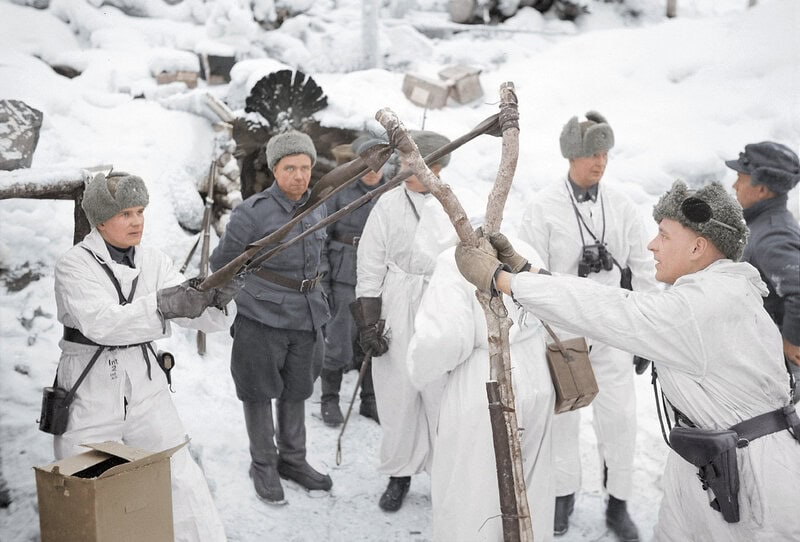
On November 30, 1939, the Soviet Union — a nation of roughly 170 million people — launched a full-scale invasion of Finland, a country of fewer than 4 million. Western observers, watching the opening moves, gave Finland perhaps two weeks before collapse. The arithmetic of the situation seemed to permit no other conclusion.
The Soviets expected something close to a capitulation. They did not get one. More immediately, they did not get adequate winter gear: Soviet troops arrived underprepared for a Finnish winter that would kill men with something approaching the efficiency of bullets. Frostbite moved through units that had been issued summer-weight equipment on the assumption the campaign would be brief.
Finland’s strategic answer was to make the landscape itself into a weapon. Dense forest, frozen lakes, and temperatures that cracked metal and jammed mechanisms became tactical assets for defenders who had spent their entire lives in exactly these conditions. The Finnish Army was outnumbered on nearly every sector of the front, but it was never outmatched for terrain knowledge.
Häyhä was mobilized and deployed to the Kollaa River sector in the Karelia region — a stretch of front his unit was expected to hold against Soviet forces that outnumbered them significantly. It was, by any reasonable military assessment, a very difficult assignment. Häyhä appears to have treated it as a job.
The Rifle, the Scope, and the Choice That Defined Everything
His primary weapon was the Finnish M/28-30, a domestic variant of the Mosin-Nagant bolt-action rifle — standard military issue, not a specialized sniper instrument built to order. What made it lethal was the man behind it and one critical decision he made about how to use it.
Häyhä chose iron sights over a telescopic scope. This is the detail that tends to stop people when they first encounter it, because a scope seems obviously superior — more magnification, more precision at range. But Häyhä understood the specific conditions of his war. A telescopic sight raises a shooter’s head higher above cover to achieve eye relief. It also produces a glint of glass in low winter light that can catch a trained observer’s eye across several hundred meters of open snow. Iron sights required none of that exposure. They kept him smaller, lower, and darker against the white.
The trade-off was that every shot demanded he know his range, his wind drift, and his trigger pull by pure instinct — skills that do not come from military training alone. They come from years of competitive shooting in peacetime, in the same kind of cold, at targets that do not forgive errors. Häyhä had those years. He had also developed a habit of compressing the snow around his firing position before settling in, so that the muzzle blast of each shot would not kick up a visible puff of white powder to mark his location to any observer watching.
History has a way of being quietly ironic: the most lethal sniper in documented history used the least sophisticated optics available to him — by choice.
It is also worth noting that the rifle was not Häyhä’s only weapon. Finnish records credit him with additional kills using a Suomi KP/-31 submachine gun during close-quarters engagements, kills that fall outside his sniper tally entirely. The 505 figure captures only what he achieved at distance, with iron sights, prone in the snow.
One Hundred Days, Five Hundred Dead
Between approximately December 1939 and March 1940, Häyhä accumulated at least 505 confirmed sniper kills. The word “confirmed” matters here: these were deaths verified by a second party, which means the true total was almost certainly higher. Unwitnessed kills, kills in chaotic firefights, kills in sectors where no Finnish observer was present to record them — none of those count in the official tally.
The rate works out to roughly five deaths per day, every single day, for one hundred days. That number only becomes properly staggering when placed alongside the broader history of military sniping: most decorated combat snipers across the entirety of either World War are credited with a few dozen kills across years of service. No other sniper in the modern era approaches a documented tally at this rate or concentration.
Soviet commanders responded in the only ways available to them: they sent dedicated counter-sniper teams tasked specifically with finding and eliminating Häyhä, and they called in artillery strikes on sectors where he was known to be operating. According to later accounts, entire Soviet units refused to advance into areas where he was believed to be active. A single Finnish farmer-soldier had become, in the language of military operations, a force-multiplication problem.
The counter-sniper teams failed. Soviet doctrine favored coordinated fire from multiple positions to flush a concealed shooter into the open. Häyhä countered this by moving constantly between shots and by using the deep snowpack and heavy tree coverage of the Kollaa terrain as his architecture. The artillery found his old positions. It rarely found him.
The name “White Death” moved through Soviet ranks as something that had crossed the boundary between military intelligence and folklore — which is precisely the kind of psychological damage that a single effective sniper can inflict on a unit’s willingness to cross open ground. Fear of an unseen marksman degrades unit cohesion in ways that conventional artillery cannot replicate: soldiers who might advance against shellfire will hesitate when the threat feels personal, targeted, and invisible.
March 6, 1940 — The Bullet That Found Him
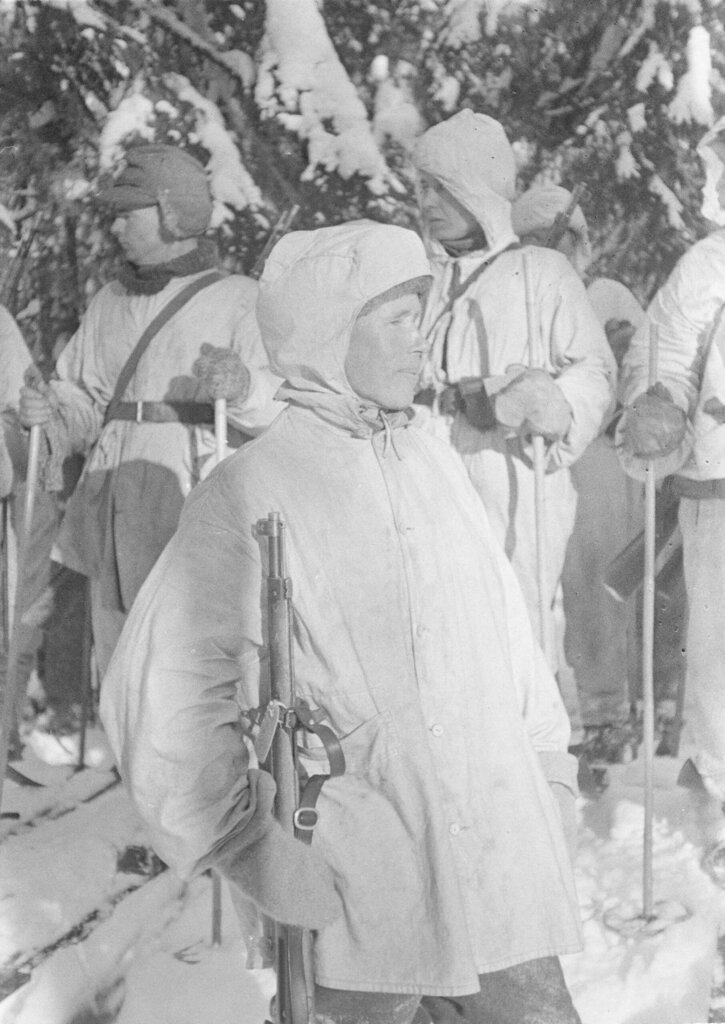
The Winter War was nearly over when it happened. On March 6, 1940, Häyhä was struck by a Soviet soldier’s explosive bullet in the lower left jaw. The wound was catastrophic. Finnish soldiers who reached him believed, initially, that he was dead. He was unconscious when they carried him from the field.
He regained consciousness on March 13, 1940 — the day the Winter War officially ended under the terms of the Moscow Peace Treaty. Even accounting for the fact that history rarely arranges itself this neatly, the timing has a quality that is difficult to set aside.
Häyhä survived. He underwent years of reconstructive surgery and recovered, by most accounts, with a characteristic absence of drama about the whole thing. He lived to the age of 96, dying on April 1, 2002 — having outlasted the Soviet Union itself by more than a decade. The nation that sent artillery barrages and counter-sniper teams to kill him dissolved before he did.
The Context the Legend Tends to Obscure
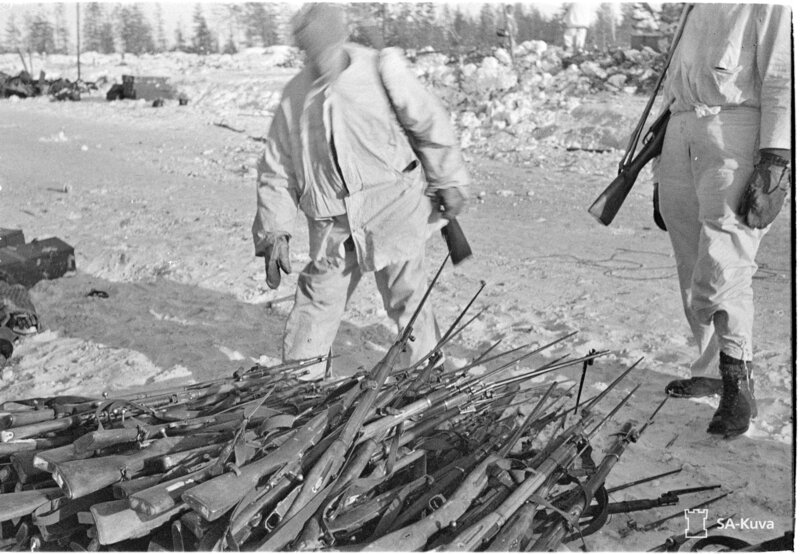
Häyhä operated as part of a broader Finnish defensive effort that combined terrain exploitation, small-unit mobility, and exceptional individual marksmanship across multiple sectors — not Kollaa alone. The motti tactics used by Finnish commanders to encircle and destroy isolated Soviet columns in dense forest were as strategically significant as any individual soldier’s contribution. Häyhä was the most lethal expression of a wider Finnish approach to asymmetric defense; understanding him in isolation risks understating how thoroughly Finland had prepared its people and its doctrine for exactly this kind of war.
It is also worth acknowledging the limits of the historical record. Finnish wartime documentation was kept under conditions of active combat, and Soviet casualty records from the Winter War period remain incompletely declassified. The 505 figure is the most widely cited and most carefully sourced number available, but military historians note that kill-count verification in any conflict involves methodological constraints that make absolute precision elusive. The record stands — it simply stands with the appropriate caveats that serious history requires.
What He Left Behind
In the interviews Häyhä gave in his later years, he was notably quiet about the war. He deflected mythology with the same patience he had once used to wait out Soviet counter-snipers. When asked how he had become so accurate, he reportedly gave an answer that strips any romantic interpretation to its bones: “Practice.”
His legacy sits at a specific, uncomfortable intersection. Military historians credit him as the deadliest sniper ever documented; Finland claims him as a symbol of national survival against overwhelming odds. Both things are accurate, and neither quite captures what the record actually shows. The Winter War, despite the extraordinary resistance of Finnish defenders, ended with Finland ceding roughly eleven percent of its territory under the Moscow Peace Treaty. Häyhä’s Kollaa sector held. It was one of the very few places along the entire front that did.
What the story of Simo Häyhä ultimately records is not a superhuman. It is a very specific kind of human: a man raised to patience, cold, and marksmanship by a particular landscape, placed by the accident of history into the exact conditions those skills were built for. The Soviet Army sent a nation’s worth of resources to find him in the snow. He had spent thirty years learning that snow before they arrived.


