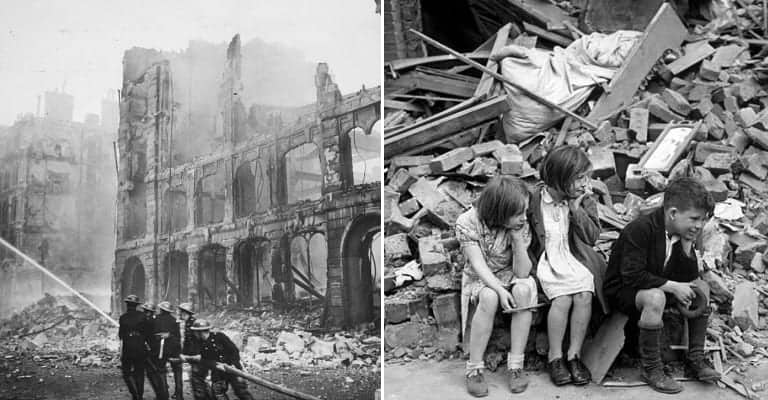

19. The impact of the Battle of Britain
The Germans suffered higher casualties than their British opponents during the Battle of Britain, in both the number of airplanes lost and the number of aircrews killed and wounded. Still, after shifting to night bombing, the British only achieved a rate of downing 1.5% of the bombers sortied by the Germans throughout the Battle of Britain and the Blitz. The British demonstrated huge advances in air warfare, in particular the use of radar for controlling air squadrons from the ground, guiding them to interception of their targets. The German policy failures regarding the interdiction of convoys and the destruction of escorts contributed to the British ability to hang on until the Luftwaffe was needed elsewhere. Neither side shot the other “out of the sky”. When the Germans abandoned the continuous bombing attacks the British defenses were reeling, near the end of their proverbial rope.
The Battle of Britain and the images of the City of London’s courageous resistance did much to bring pro-British sentiment to the forefront in the United States, leading to lend-lease, convoys, and increasing American assistance in the Battle of the Atlantic. But probably its most important impact on the war was the reduction of experienced crews and combat ready aircraft for use against the Soviets in Operation Barbarossa. By the end of the summer of 1941, British bombers were attacking German cities in ever increasing strength (at night), British troops were fighting the Germans in North Africa and elsewhere, and American destroyers were assisting in the convoying of ships carrying the necessities of war to the British Isles. Churchill’s strategy throughout the Blitz had been to simply hang on as long as possible. In the end, it worked.
Where do we find this stuff? Here are our sources:
“How Bomber Command Helped Win The Battle Of Britain”. Imperial War Museums
“Operation Sea Lion: The German Plan to Invade Britain 1940”. Egbert Kieser. 1999
“Fighter: The True Story of the Battle of Britain”. Len Deighton. 2000
“The First and the Last: Germany’s Fighter Force in WWII”. Adolf Galland. 2005
“The Most Dangerous Enemy: A History of the Battle of Britain”. Stephen Bungay. 2000
“The Luftwaffe Bombers’ Battle of Britain”. Chris Goss. 2000
“British Intelligence in the Second World War”. F. H. Hinsley. 1979
“The Blitz”. Maureen Hill. 2002
“The Blitz”. Entry at Merseyside Maritime Museum. Online
“Hitler and Air Strategy”. Richard Overy, Journal of Contemporary History. July, 1980
“CH – The First Operational Radar”. B. T. Neale, The GEC Journal of Operational Research. 1985
“How St. Paul’s Survived the Blitz”. BBC News Magazine. December 29, 2010. Online
“The Secret War”. Brian Johnson. 2004
“Erich Raeder: Grand Admiral”. Erich Raeder. 2001
“May Blitz”. Entry, Merseyside Maritime Museum. Online
“The Night Blitz: 1940 – 1941”. John Ray. 1996
“The Blitz: Westminster at War”. William Samsom. 1990
“The Myth of the Blitz”. Angus Calder. 2012
“The Blitz, Then and Now, Volume 2: After the Battle”. Winston Ramsey. 1987
“20 Photographs Depicting British Children During the Blitz of World War II”. History Collection


