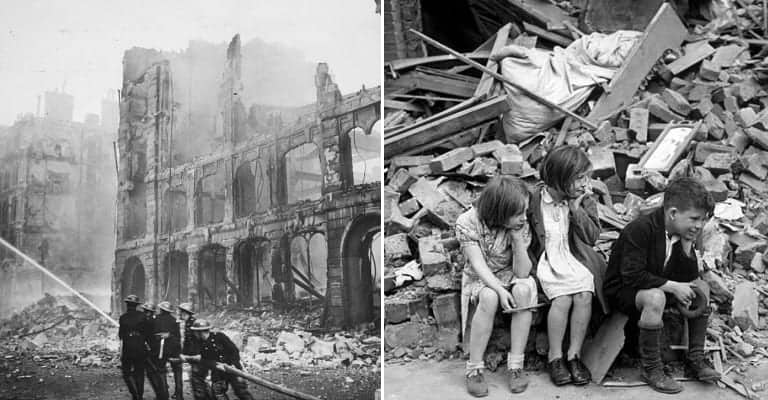

11. The Second Great Fire of London, December 29, 1940
London endured what was probably its worst night of the Blitz just after Christmas, 1940. After a week during which a series of raids struck British cities in the East Midlands, a raid on London consisting of about 130 bombers struck the City of London, the metropolis’ historic center. The Germans dropped incendiary bombs from aircraft designated as pathfinders. These ignited fires were used by following German aircraft to find and concentrate on their target, which dropped high explosive bombs into the flames. It was during the aftermath of this raid that the famed photographs of St. Paul’s Cathedral wreathed in flames and smoke were taken. When Churchill saw the photograph in the Daily Mail, he messaged that St. Paul’s, “must be saved at all costs”.
The resulting fire storm which swept through the City of London covered an area of greater size than the Great Fire of London of 1666. Several American war correspondents were in the City and reported on what they saw, including Edward R. Murrow, who reported St. Paul’s in flames, “burning to the ground as I talk to you now”. Ernie Pyle, who would become one of America’s most respected war correspondents before his death in the far Pacific, wrote, “Pinkish-white smoke ballooned upward in a great cloud, and out of this cloud there gradually took shape – so faintly at first we weren’t sure we saw correctly – the gigantic dome of St. Paul’s Cathedral. St. Paul’s was surrounded by fire, but it came through“. It was later discovered that an incendiary bomb was wedged in the timbers of the dome, but had failed to detonate.


