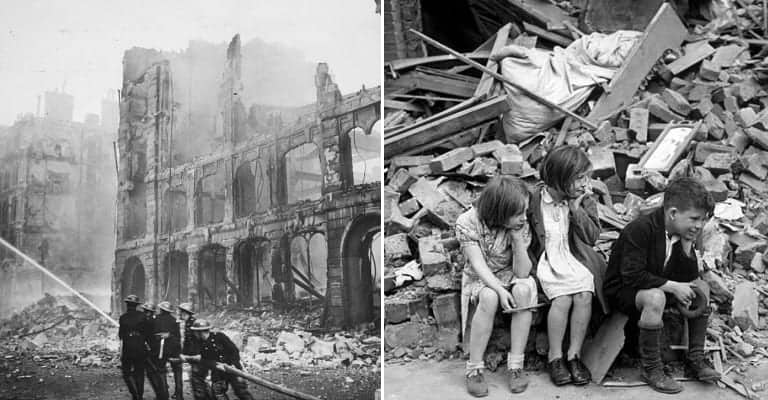

18. The truth behind the myth of the Blitz
Through the use of Churchill’s rhetoric and through the efforts of news correspondents, many of them Americans who were eyewitnesses to the Blitz in London, the heroism and courage of the British people and their “tiny” air force resisting the Nazis entered history as representing a fully united and determined people. Everyone was portrayed as accepting their lot uncomplainingly and unflinchingly, inspired by the bulldog Winston Churchill. While it is true that the British people endured hardships and continuous peril throughout the Blitz, it is equally true that class divisions, long a feature of life in Great Britain and its empire, were prevalent in the national reaction to the emergency. Calls for a negotiated peace were heard throughout the period, particularly from the working class, and supported by Great Britain’s Communist Party.
The British shifted their offensive bombing strategy to more closely resemble the German model following the Blitz, adopting the use of incendiary bombs and creating plans to destroy city centers. This was based on the observation that when the centers of cities were destroyed administrative, financial, and transportation operations were all disrupted, often for greater periods of time than was the case with the destruction of industrial facilities. British Bomber Command reacted by adopting the concept of area bombing, with the goal of disrupting the German economic base. The British also recognized the increased destruction from the fires caused by incendiary bombs. The failure of the Luftwaffe to force the British into a negotiated peace was the first defeat inflicted on the Germans in the Second World War and a lesson well learned by their British opponents.


