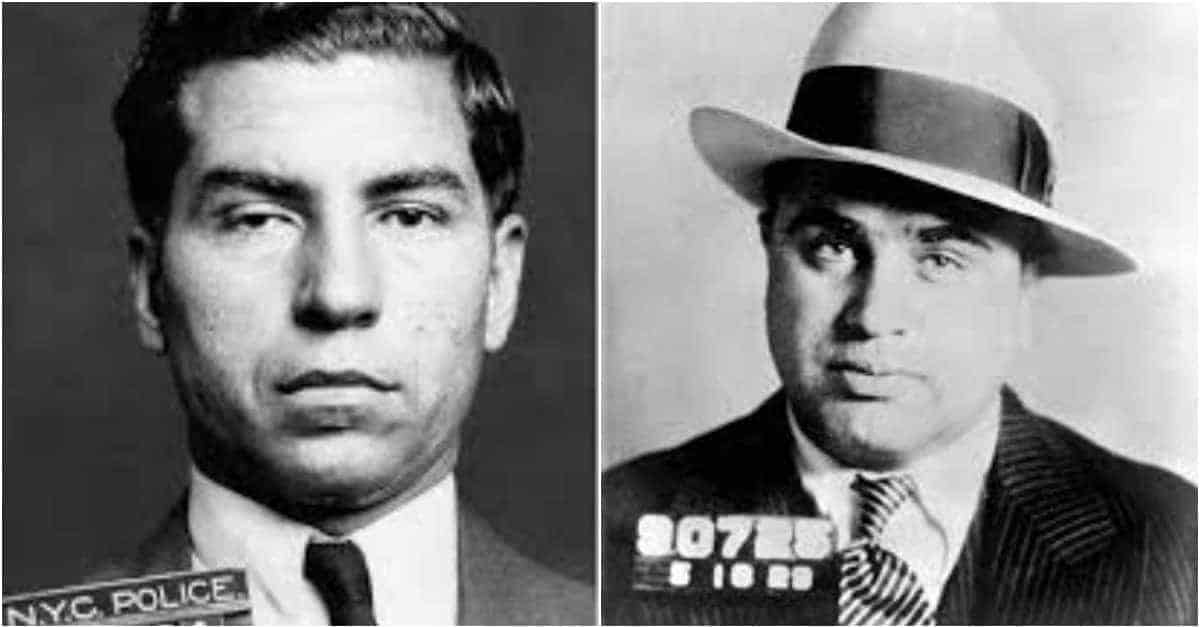

Lucky Luciano
Charles “Lucky” Luciano (1897 – 1962) was a visionary crime boss who founded today’s Genovese crime family, and with his establishment of The Commission – a committee running the Italian-American mafia and arbitrating its internal disputes to avert bloody struggles disruptive to business – is considered the godfather of modern American organized crime.
A criminal since childhood, he emigrated to the US at age 9, and by age 10, was involved in shoplifting, mugging, and extortion, and at 19, he was sentenced to six months for selling heroin. In 1920, he joined Joe Masseria’s crime family, and became his chief lieutenant, running his bootlegging, prostitution, and narcotics operations – the notion that the mafia stayed away drugs is just a myth popularized by The Godfather. In reality, the mafia was heavily involved in the drug trade from the start, and Luciano would go on to become America’s biggest narco king, long before Pablo Escobar. For decades, the mafia was the biggest importer of hard drugs into the US, particularly heroin. It was not until cocaine supplanted heroin as the hard drug of choice, and the rise of the Colombian cartels in the 1970s, that the mob lost its top billing as America’s biggest drug trafficker.
In 1929, in the runup to the outbreak of the Castellamarese War between Masseria and Salvatore Maranzano, Luciano was abducted by Maranzano’s men, tortured for hours, stabbed repeatedly with an ice pick, had his throat slit from ear to ear, and was then dumped and left for dead on a Staten Island beach. Miraculously, he survived – earning him the nickname “Lucky”.
The 1930 – 1931 Castellamarese War was anathema to Luciano, who decried the publicity and disruption of business. When the tide turned against Masseria, Luciano cut a deal with Maranzano, then had Masseria killed. Five months later, he had Maranzano killed as well, after which he established The Commission – a committee to regulate mafia operations in the US and avert similar wars.
Luciano’s downfall came after he ignored advice to step back from direct involvement in his prostitution operations. That left him vulnerable to prosecution by reformist New York crusader Thomas Dewey, who won a conviction of forced prostitution against Luciano in 1936 and got him sentenced to 30 years in prison. He was serendipitously saved by WWII, whose outbreak gave Luciano’s friend and associate Meyer Lansky an opportunity to negotiate a deal with the US Navy to commute Luciano’s sentence in exchange for mob assistance in protecting New York’s harbor. After the war, Luciano was freed on condition that he agree to deportation, and in February 1946, he sailed from Brooklyn to Italy, never to see the US again.
Later that year, he moved to Cuba to be closer to the US and his operations therein, and in December 1946, a conference was held in Havana between Luciano and major crime bosses to discuss mafia plans for expanding gambling operations in Havana and Las Vegas and its booming narcotics trade. Soon after the Havana conference, American authorities caught wind of Luciano’s presence in Cuba and pressured the authorities to deport him, which they did in February of 1947.
Thereafter, he was kept under close surveillance by Italian police and had various restrictions placed upon his freedom of movement within Italy, including a prohibition against entering Rome, and revocation of his passport to prevent his travel abroad. Luciano remained in Italy, until his death of a heart attack in 1962. The US government granted his relatives permission to return his body to America, where it was buried in a Queens cemetery.
Also Read: Lucky Luciano Helped the US Invade Italy from a Prison Cell


