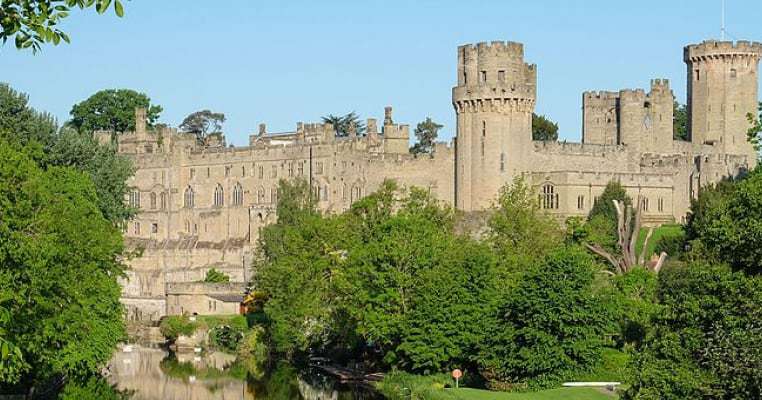

Stirling Castle
Like Edinburgh Castle, Stirling Castle was built atop an imposing natural feature, in this case an intrusive crag, and was also occupied as a hill fort in the Iron Age. It occupied a strategically important position: beyond the defensive possibilities afforded by the crag, Stirling Castle overlooks a downstream crossing of the River Forth, and thus for centuries whoever occupied it controlled any movement across the river. Consequently, Stirling was involved in all of Scotland’s major conflicts, and besieged 8 times. Most of today’s castle dates from the 15th and 16th centuries, when it became an important royal palace.
In April 1304, during the Wars of Scottish Independence, Edward I of England laid siege to the castle, which was the last remaining stronghold in Scottish power. He had assembled 17 siege engines for the attack, and on July 20th the castle surrendered. Unfortunately, Edward had just finished construction of Warwolf, the largest trebuchet ever built, and was determined to use it. Warwolf was so large that, when disassembled, it needed 30 wagons to transport it, and could hurl projectiles weighing 136kg. Sending the truce party back to the castle, Edward totally levelled a large part of the curtain wall.
Stirling Castle also overlooks Bannockburn, where in 1314 Robert the Bruce secured the most famous victory of the Scottish Wars of Independence. By this time, Edward I had been succeeded by his ineffective son, Edward II, whose reign was an unmitigated disaster. At the battle, 10, 000 Scots, mostly on foot, defeated 25, 000 English troops of whom a large part were mounted. Boggy ground and fighting uphill made the English cavalry ineffective, and they were roundly slaughtered by the Scottish army. The battle itself was fought to save Stirling Castle, which Robert the Bruce was then successfully besieging.
Under the Stewart Kings, who came to power in Scotland in the late 14th century, Stirling Castle was transformed into a Renaissance palace between 1490 and 1600. Its surviving architecture displays a mixture of English, French and German influences, and it was home to musicians, clerks, and several alchemists. In 1507, one of these alchemists, Father John Damian, built a pair of wings out of feathers based on Leonardo da Vinci’s design and leaped from the castle walls in an attempt to fly. He of course failed, luckily only breaking his thigh bone, and blamed hen’s feathers for his crash-landing.


