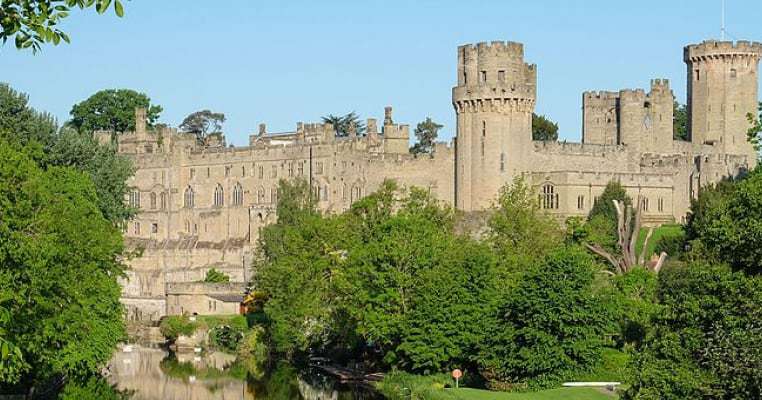

Edinburgh Castle
Perched on a rocky outcrop over Scotland’s capital city, Edinburgh Castle has been a fortification since at least the Iron Age, and has a claim to be the most besieged place in Britain after enduring 26 sieges. Like Windsor Castle, Edinburgh Castle in its current form boasts a variety of architecture from different periods, but this is less the result of aesthetic taste than its buildings being destroyed by hostile armies. The rock upon which it stands is an extinct volcano formed 350 million years ago and standing at 130 metres above sea level, 80 metres above the surrounding area.
Legend has it that Edinburgh Castle was built by Ebraucus, legendary King of the Britons, but the stronghold’s importance through the early middle ages is much better-evidenced archaeologically. Edinburgh Castle was the home of the future Saint Margaret of Scotland (c.1045-93), who died of grief after hearing of the death of her husband, King Malcolm III. In Margaret’s time the city of Edinburgh became the established set of Scottish royal power, a decision aided no doubt by the seeming-impregnability of the castle. The literal and symbolic elevation of the royal family above their subjects would also have been appealing.
Edinburgh Castle was at the centre of conflicts between the English and the Scots. It was occupied by the English for 22 years in the late 12th century after King William the Lion was defeated by Henry I of England at the Battle of Alnwick and had to surrender the castle as part of a peace treaty. The castle saw direct action in 1296, when King Edward I of England, known as the ‘Hammer of the Scots’, took advantage of the unstable Scottish crown to make himself Scotland’s feudal overlord. The castle surrendered after 3 days of bombardment.
The castle was retaken in 1314 (after Edward I’s death), but this came at a great price, for the decision was made to blow up the armaments to prevent its refortification in the event of another English capture. It continued to swap hands through the Scottish Wars of Independence, but when the English had more or less established rule over Scotland, Edinburgh Castle was repaired and extended to incorporate comfortable apartments and state rooms. The Great Hall was completed by 1458, but increasingly the castle was used as an arsenal. The famous gigantic cannon, Mons Meg, was added in 1457.
Perhaps the bloodiest siege took place in 1573, when 1, 000 English troops armed with 27 cannon fired 3, 000 shots at the castle. After 12 days, the castle finally surrendered when much of it was destroyed. Following many further conflicts between England and Scotland, the 1603 coronation of James VI of Scotland, son of Mary Queen of Scots, as King James I of England united the kingdoms, and from 1660 to 1923 a garrison was always stationed at the castle. Its last military action took place in 1745 when it successfully withstood a siege during the Second Jacobite Uprising.


