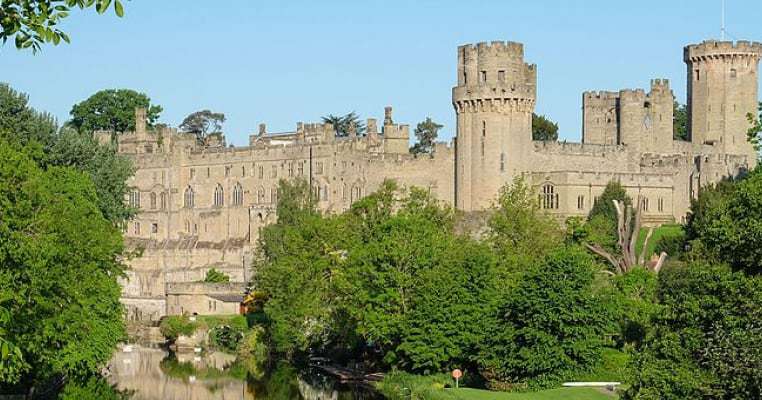

Warwick Castle
Warwick Castle is built on a sandstone bluff above the River Avon, which also flows through Stratford-upon-Avon, Shakespeare’s birthplace. Its origins lie during the early 10th century, when Ethelfleda, daughter of Alfred the Great, built a burh to defend the area against the invading Vikings. William the Conqueror (who else?) turned the Saxon fortification into a motte and bailey castle in 1068, and the stone edifice that survives today was started in 1260. Its impressive outer defensive walls incorporate ‘murder holes’, openings from which boiling tar or human waste could be poured on attackers climbing up siege ladders.
Warwick fell to perhaps the most audacious and bloodless capture in the history of castles. In 1153, England was embroiled in The Anarchy, when the throne was disputed, and the son of the rival claimant Empress Matilda, Henry of Anjou, invaded with the intention of seizing power. Arriving at Warwick Castle, Henry convinced the wife of Roger de Beaumont, 2nd Earl of Warwick, who was loyal to King Stephen, that her husband had died, and she foolishly handed over the castle. Roger is said to have dropped dead upon hearing the news, and Henry became king of England in 1154.
The castle was taken under more conventional means by Simon de Montfort during the Second Barons’ War (see Kenilworth Castle, above). He launched a surprise attack on the newly-stone castle in 1264, laying waste to the defensive walls, and succeeded in capturing Earl William Mauduit and his wife. Simon imprisoned and held to ransom the royalist couple in Kenilworth Castle. Warwick itself was also used as a prison, and hosted the notorious Piers Gaveston, lover of King Edward II, in 1312 before his execution, and King Edward IV for a period in 1469 during the Wars of the Roses.
Warwick Castle is also famous for its horrific dungeon, which dates back to 1345. Located underground, barely any natural light would have reached it in its heyday, and the walls are covered in graffiti carved by prisoners, including one from the English Civil War – when the castle was used to confine Royalist soldiers – who laments his 4 years’ incarceration. Warwick Castle is also associated with the murky period of witchcraft in England. Moll Bloxham, an old woman who was dismissed for selling dishonest measures of dairy products, died cursing the Earl of Warwick’s cattle after being banished.


