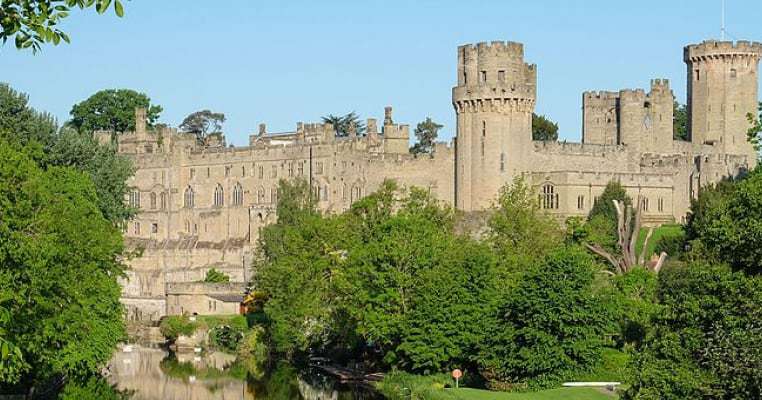

Kenilworth Castle
The extensive remains of Kenilworth Castle match its historical significance. As it stands, Kenilworth represents 5 centuries of military architecture, from its Norman origins to the English Civil War. It was founded by Henry I’s treasurer, Geoffrey de Clifton, in the early 1120s, and the great tower possibly dates from his original foundation. It was fortified and redesigned until its partial destruction during the Civil War, serving as both stronghold and palace and passing from aristocratic to royal hands and back again. Until it fell into ruin, Kenilworth Castle remained very much at the centre of English history.
It was seized by Henry II when his his wife and sons rebelled against him in 1173, and was passed onto one of those rebellious offspring, ‘Bad’ King John, who celebrated being excommunicated by the Pope by rebuilding and modernising several royal residences including Kenilworth. His son, Henry III, in turn granted it to Simon de Montfort in 1244. This proved a grave error, as the disgruntled de Montfort became a leader in the Second Barons’ War (1264-67) against the spendthrift and autocratic Henry III, and used Kenilworth Castle as the centre for his military operations against the crown.
De Montfort died at the Battle of Evesham (1265), and his son, also called Simon, agreed to surrender the castle to the king. However, his forces rejected the terms, and so began the Siege of Kenilworth Castle in 1266, which in lasting 6 months is the longest siege in English history. Despite attacking the castle with trebuchets, siege towers, and a wealth of arrows, the castle’s defences were far too strong for the royalist army. Its defensive walls and impressive water features rendered the castle impregnable, and the forces at Kenilworth only surrendered when their provisions ran out.
In 1533 Kenilworth Castle passed into the hands of John Dudley, who not long afterwards was executed for his part in the temporarily-successful plot to put Lady Jane Grey (‘the Nine Days’ Queen’) on the throne. John’s son Robert, Earl of Leicester, inherited the castle after the succession of Elizabeth I, to whom he was a favourite and long-term suitor. Robert set about a grand redesign and extension of the castle in order to attract Elizabeth to visit, transforming it into a Renaissance palace. In 1575, Robert made a final unsuccessful attempt to convince Elizabeth to marry him.
Robert almost bankrupted himself with the architectural additions and lavish entertainment for this particular visit. Elizabeth arrived with an entourage of 31 barons and 400 servants and stayed for 19 days, the longest she ever patronised a private home on her tours. Robert organised hunting, bear-baiting, plays, and fireworks, at a cost of at least £1, 700, which was a fortune in Elizabethan times. Kenilworth was a Royalist stronghold during the English Civil War, but was captured by Parliamentarians in 1642, and eventually ‘slighted’ (deliberately destroyed) in 1649, to prevent its recapture and fortification by Charles I’s army.


