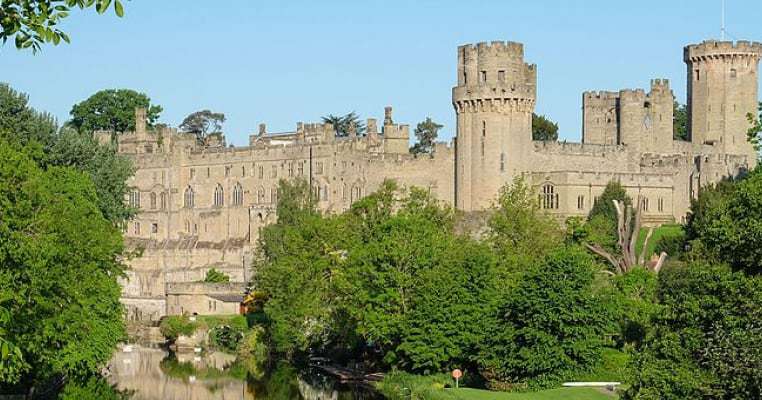

Leeds Castle
Self-described as ‘the loveliest castle in the world’, Leeds Castle is an example of a castle that served more as a crenellated home than a military stronghold like nearby Hever. Located on two islands in the Kent countryside (rather than the city in Yorkshire of the same name), the setting of Leeds Castle perhaps best epitomizes the common conception of a castle in the popular imagination. Its origins, however, were dogmatically military: in 857 a Saxon chief called Led (from whom the modern name ‘Leeds’ derives) built a wooden fortification on two natural islands in the River Len.
It was first built as a stone castle in 1119 by Robert de Crevecoeur, who linked the two islands with a drawbridge. 20 years later it was attacked by King Stephen during The Anarchy, but withstood a siege and the maelstrom of 12th-century politics to remain in the de Crevecoeur family. Little remains of de Crevecoeur’s building today, but more substantial parts survive from Edward I’s period of ownership. Edward’s first wife, Eleanor of Castile, purchased Leeds Castle in 1278, and set about making it into a more comfortable home, incorporating a gloriette (a high building affording pleasant views).
When Eleanor died, Edward set about improving both the castle’s defences and domestic comfort, building a rare medieval bath house. His imprudent son, Edward II, gave the castle to one Bartholomew de Badlesmere, who responded by refusing to let Edward’s queen visit, and so the castle was besieged and its churlish owner beheaded. From this time until the late 14th century the castle was traditionally given to the Queen of England. Despite its hospitable nature, the castle also served as a prison for Henry V’s stepmother, accused of plotting to poison the king, for a period the early 15th century.
The castle’s military function was all but ended by Henry VIII, who set about a lavish period of redevelopment to make it more comfortable. It was a favoured palace of Henry and his first wife, Catherine of Aragon, who once visited the castle with an entourage of 5, 000 in 1520. Unfortunately, much of the medieval castle was demolished over a period of insensitive redevelopment from the Jacobean to the Victorian period, though aspects and features can still be traced in today’s castle. At the very least, Leeds Castle offers a perspective on changing tastes and ancient attitudes to conservation.
Where did we find this stuff? Here are our sources:
Alexander, Marc. The Welsh Castles Story. Stroud: The History Press, 2015.
Allen Brown, Reginald. Allen Brown’s English Castles. Woodbridge: The Boydell Press, 1976.
Forde-Johnston, James. Great Medieval Castles of Britain. London: Book Club Associates, 1979.
Johnson, Paul. The National Trust Book of British Castles. London: Weidenfeld & Nicolson, 1978.
Parnell, Geoffrey. The Tower of London: Past & Present. Stroud: The History Press, 2009.
Sorrell, Alan. British Castles. Hastings House Publishers, 1973.
Tabraham, C. J. Scottish Castles. Glasgow: HarperCollins, 2005.


