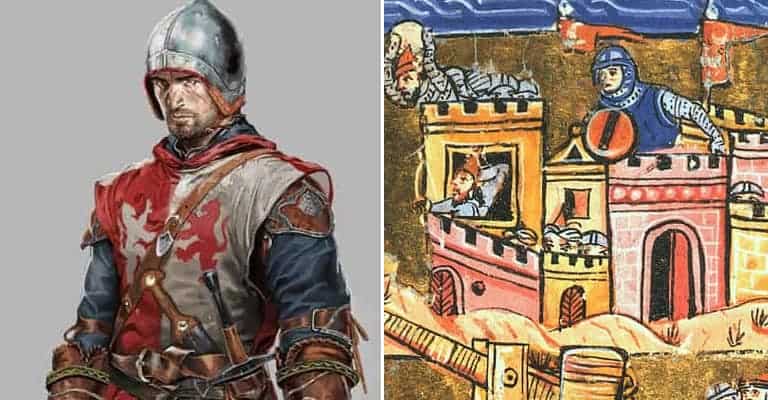

11. You Provided Your Own Food and Clothes
Standing armies usually provide their soldiers with uniforms, food, weapons, and other necessities for keeping men and women happy and fit for battle. Greek, Persian, and Roman armies along with many other ancient military forces, equipped soldiers with uniforms so that they could more easily identify who the enemy was (and also scare the enemy with the enormity of their ranks). In the Middle Ages, though, the only standing army was the Knights Templar. Armies were compiled of farmers who dropped their farming implements in favor of swords and other fun toys that they could play within battle.
As such, the leaders didn’t have the resources (or time or patience) to clad their soldiers in uniforms. They didn’t even provide them with food or weapons. All of those things were the responsibility of the soldier. If someone wanted the prestige of fighting in a battle, that person had to bring his or her equipment. Soldiers often fought in the regular tunics that they used while farming. Charlemagne, the Frankish king of the eighth century, specified what soldiers were to bring when they showed up:
“Each horseman shall have a shield, lance, sword, dagger, bow, and quivers with arrows; and in your carts utensils of various kinds, that is, axes, planes, augers, boards, spades, iron shovels, and other utensils which are necessary in an army. In the carts also supplies of food for three months, dating from the time of the assembly, arms, and clothing for a half-year.”


