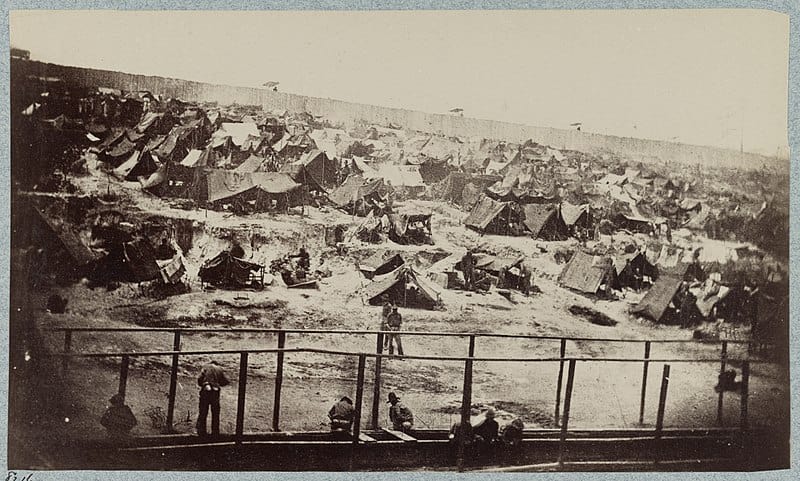

20. Many of the Camp Sumter prisoners died on their way home
In late April 1865, with the war over, the riverboat Sultana prepared to depart Vicksburg, Mississippi, to travel north. Outside Vicksburg was a Union parole camp, which held prisoners exchanged from Confederate camps, most of them from Camp Sumter. Though Sultana’s design allowed a capacity of 376, including crew, an estimated 1,960 survivors of the Confederate camps crowded aboard the vessel. Over 2,100 people left Vicksburg in the steamboat, which also carried cargo bound upriver. Sultana departed Vicksburg on April 24, 1865. As the vessel steamed north it made stops at Helena, Arkansas, and Memphis, Tennessee, discharging and taking on cargo and passengers. About 200 men remained behind in Memphis, the rest continued upriver approximately 7 miles, when the steamboat suffered an explosion. The vessel’s wooden superstructure was severely damaged and set ablaze.
At least three separate explosions were reported by survivors, leading some to suspect sabotage by Confederate agents. Over 1,000 men who had survived the horrors of Camp Sumter died in the explosion, fire, or drowning when they tried to escape by swimming. The Mississippi River that spring was near flood, with a strong current. Even the strongest swimmer would have experienced difficulty reaching the banks. In their weakened condition, few of the former prisoners of war could make it without help. The official cause of the explosions found that three of Sultana’s four boilers exploded, due to mismanagement of their water levels. At least three individuals claimed to have sabotaged the steamboat, by varying means. All have been discredited. Boiler explosions on steamboats were not uncommon, and Sultana’s had been problematic. The tragedy is remembered with historical markers in several locations along the Mississippi and Ohio Rivers.
Where do we find this stuff? Here are our sources:
“History of the Andersonville Prison”. Article, National Park Service (NPS). Online
“Anderson Prison”. Article, American Battlefield Trust. Online
“Daily Life at Andersonville Prison”. Virtual Exploration, Google Arts and Culture. Online
“Prison Camps of the Civil War”. Bruce Catton, American Heritage Magazine. August 1959
“The Last Confederate Prison”. Editors, American Heritage Magazine. Fall, 2010
“Fugitive Federals”. Article, arcgis.com. Online
“The Legacy of Andersonville Prison; Who is to blame?” Article, The History Engine. Online
“Union Private Describes Raiders at Andersonville Prison” Article, The History Engine. Online
“General John H. Winder, CSA”. Arch Frederic Blakey. 1990
“The Sultana Disaster”. Article, American Battlefield Trust. Online


