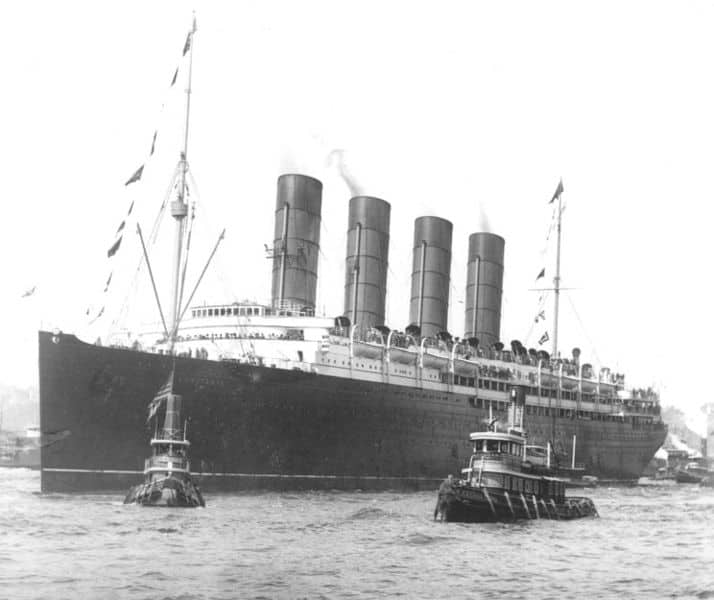
4. Lusitania exhibited several problems during sea trials

Lusitania underwent sea trials beginning in the summer of 1906. Several problems exhibited themselves, the most serious of which was the ship’s tendency to vibrate severely at both bow and stern at high speeds. The vibration at the stern was severe enough that the second-class cabins could not be occupied. The second-class area was gutted to install stiffeners, and then rebuilt. The effort reduced the vibration but did not eliminate it entirely, and the problem remained for the rest of the ship’s operational life. Lusitania was thus restricted to speeds which were less than its designed capability.
Turning the rudder to its maximum angle took a full twenty seconds, and increased the vibration in the stern. Overall, the ship performed well, was certified by the Admiralty and the Board of Trade, and was delivered to Cunard in August. It entered service on its maiden voyage on September 7, 1907, bound from Liverpool to Queenstown, where it anchored offshore as more passengers were ferried out to the board. The ship departed Queenstown for New York just after midnight on September 8. Such was the excitement over the new ship that a crowd of 200,000 cheered its arrival in New York on September 13, a Friday.


