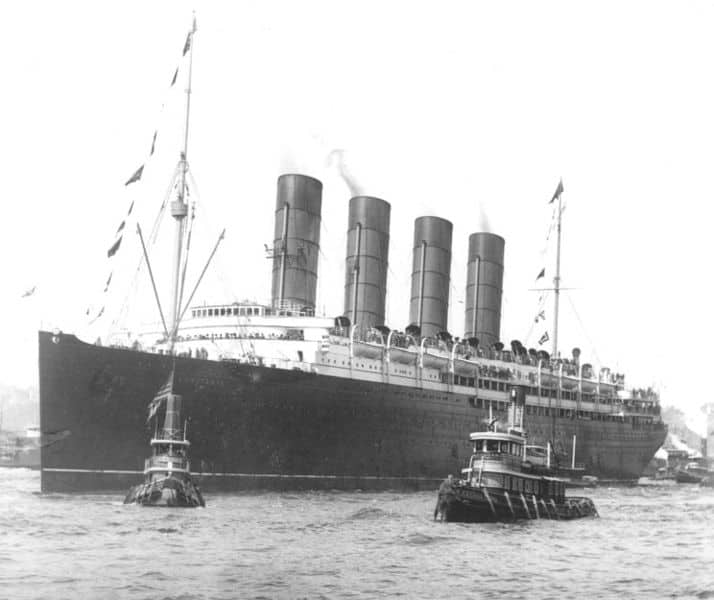
8. The British Admiralty took over the Lusitania in 1914

With war declared, the Royal Navy assumed control of RMS Lusitania, designating it an Armed Merchant Cruiser, though no arms were installed. British merchant captains were also issued orders by the Admiralty to attempt to ram German submarines which surfaced to confront them, whenever possible. The Admiralty took steps to camouflage Lusitania, changing its paint scheme and modifying its appearance during the autumn and winter of 1914-15. The liner remained in service on the Liverpool – New York run during the period, though it seldom carried more than just over half its full complement of passengers.
In late winter, Lusitania’s peacetime appearance was restored, including its color scheme, and it continued its regularly scheduled transatlantic service. The German declaration of the waters around Great Britain as a war zone was issued in February. Neutral ships were not to be attacked if they could be identified as such. Ships which could not be identified as neutral would be attacked without warning. Lusitania was ordered by the Admiralty to cease flying any flags while in the German declared war zone. Lusitania arrived in Liverpool in early March, 1915, having crossed the German war zone safely for the first time.


