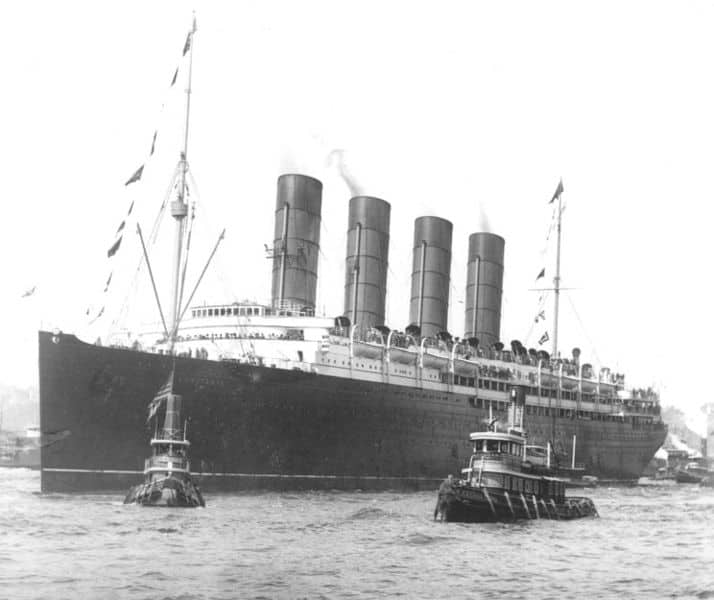
10. The Admiralty continued to list Lusitania as an Armed Merchant Cruiser

The large passenger liners offered the advantages of superior speed and cargo capacity, but those were attained through the extensive use of coal. The liners gobbled up coal at a prodigious rate, and the Admiralty needed to conserve as much as possible for the use of its capital ships should the German fleet sortie. It was decided not to arm Lusitania as originally planned, though it remained on the registry as an armed merchant cruiser. The ship was so listed in the 1914 edition of Jane’s Fighting Ships. Cunard continued to operate the ship, but it too was concerned about coal consumption. One of the ship’s boilers was shut down, which conserved coal but reduced the ship’s speed.
On its last crossing from Liverpool to New York, Lusitania was unable to exceed the speed of 22 knots using just the three remaining boilers. In New York, it took on passengers and cargo. Among the latter were several tons of munitions, including small arms ammunition. On May 1, 1915, Lusitania departed from Cunard’s Pier 54 in New York, bound for Liverpool, with 1,959 men, women, and children aboard, the majority of them British.


