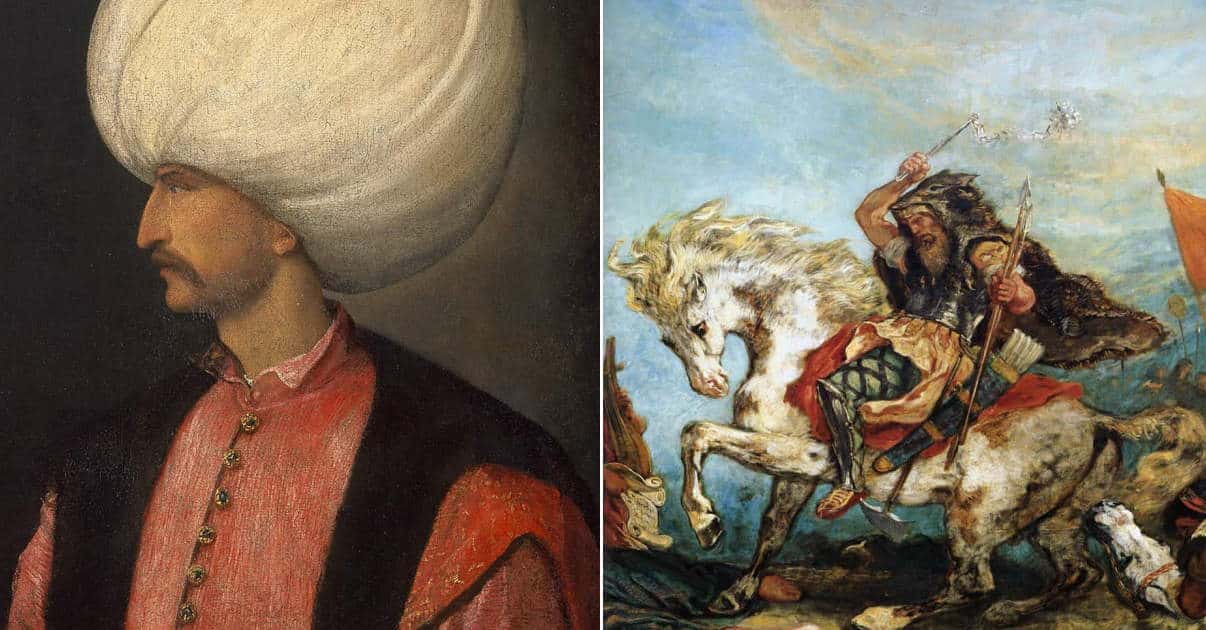

Aurangzeb
Aurangzeb was the last of the great Mughal emperors and the third of the four sons of Shah Jahan and Mumtaz Mahal, whose tomb was the Taj Mahal. He had proved himself to a great military leader while serving as his father’s Viceroy and unlike many of his family, he was a devote, orthodox Muslim, spurning Mughal sensuality and drunkenness. These two traits were to serve him well when in 1657, he began to make his power play for the throne.
That year, Shah Jahan fell dangerously ill and, the possibility of a vacant Mughal throne spurred Aurangzeb into action. His first step was to take out his eldest brother and his father’s preferred successor, Dara Shikoh. Promising his younger brothers a share of the empire to elicit their aid, Aurangzeb beat Dara at the Battle of Samurgarh in May 1658. While the heir apparently fled, Aurangzeb took their father into custody, confining him in his palace at Agra.
Although not yet emperor, Aurangzeb was now the de facto ruler of the Mughal empire. However, he had to consolidate that power. He began to erode support for Dara by calling into question his Muslim faith. Dara had been interested in reconciliation between Islam and Hinduism. So Aurangzeb, (who would later remove all Hindus from positions of authority and openly persecute Sikhs), set about portraying this tolerance as apostasy.
In the meantime, he had to eliminate his other brothers with whom he had no intention of sharing power. In 1658, he imprisoned his brother Murad for three years in the Gwalior fort after first stupefying him with alcohol. He then executed him on the trumped-up charge of the murder of the Diwan of Gujarat some years earlier. However, with Murad safely imprisoned, Aurangzeb felt confident enough to organize his coronation- even though his father still lived and would not die until 1666.
However, Dara chose this time to make one last attempt to attack his brother. Once again he failed, and Aurangzeb, now having him safely in custody, had him charged as an apostate. On August 10, 1659, Aurangzeb had Dara beheaded for this crime. Meanwhile, Aurangzeb, now free of his brothers began to remove the next generation just to be on the safe side. He had Dara’s son, Suleiman Shikoh slowly poisoned with opium until he died three years later.
But not all rulers, killed their relatives deliberately. Some died by ‘accident.’


