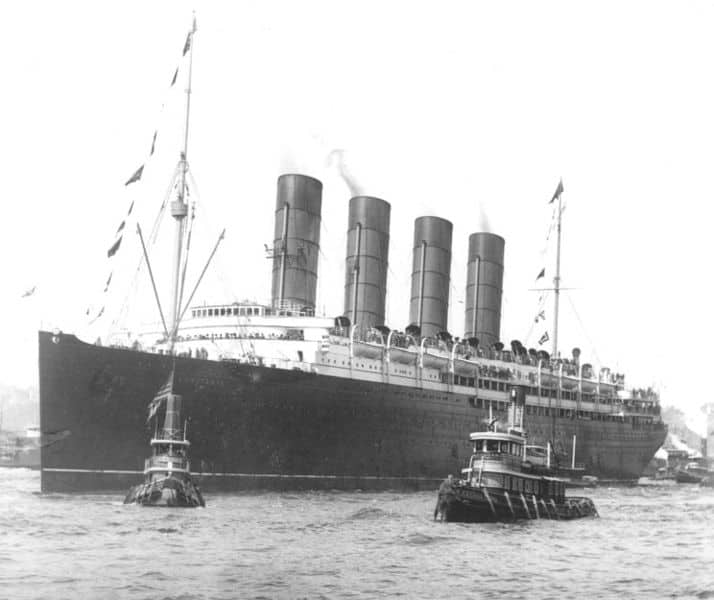
3. Lusitania was the largest ship in the world for a short time

When Lusitania was launched it was the world’s largest ship, though it held that title for but a few months before the larger Mauritania claimed it. Lusitania had a significant advantage over its German competitors; it could carry just over 50% more passengers than any other ship, with the exception of its sister. White Star plans to build Olympic and Titanic stemmed from Cunard’s competitive advantage. Passenger accommodations on Lusitania quickly obtained a reputation for offering greater space in all classes, spread across six decks which gave the ship a stately appearance. About 3,000 people were aboard at full capacity, just over 800 of them crew.
First class was situated between the first and fourth funnels, near the center of the ship, where the greatest stability was had. Its common areas were on the boat deck, and included the dining room, which comprised two decks, reading rooms, a smoking lounge, a café which could be opened to the weather on one side, and other amenities. Second-class accommodations were aft of the fourth funnel, where they were considerably more spacious than found on preceding ships. So were those of third class, which was forward of the funnels, and which set a new standard for liners. Lusitania quickly gained a reputation for superior comfort in all classes when it began service.


