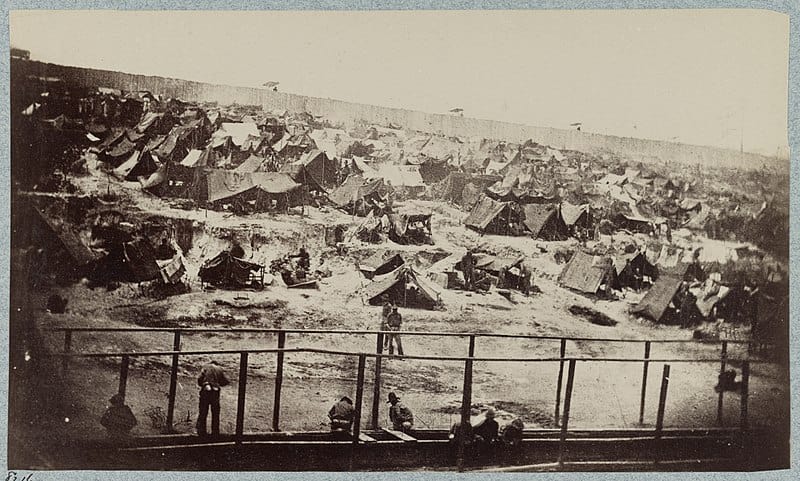

11. Daily existence among the prisoners focused on survival
Without a secure police procedure from the guards, and with the breakdown of military discipline among the prisoners, life in Camp Sumter was dangerous. In his report, Dr. Jones wrote, “…the stronger preyed upon the weaker” of the prisoners. He also reported, “…even the sick who were unable to defend themselves were robbed of their scanty supplies of food and clothing”. Social groups arose in the prison. Men collected into groups based on shared experiences, their home states and towns, and other things held in common. These groups housed together, ate together, and moved about the camp together. Some formed for mutual protection. Others formed for mutual predation. Wirz did not punish theft among the prisoners, though he punished harshly for theft of Confederate property and supplies.
Wirz’s failure to exercise control over the prisoners led to the formation of an organized gang which became known as the Andersonville Raiders. The Raiders, which numbered around 100 at their peak, used several tactics to better supply themselves in the prison. They targeted new prisoners as victims of theft. They used strong-armed tactics, theft by deception, sneak-thievery, and even murder during their brief reign of dominating the camp. In late June 1864, a victim of the Raider’s thefts requested an audience with Wirz. Wirz responded by announcing to the camp all rations were to be withheld until the prisoners turned in all of the Raiders. Wirz effectively made the prisoners responsible for their own security by denying them their food. Another group of prisoners organized as what they called the Regulators.


