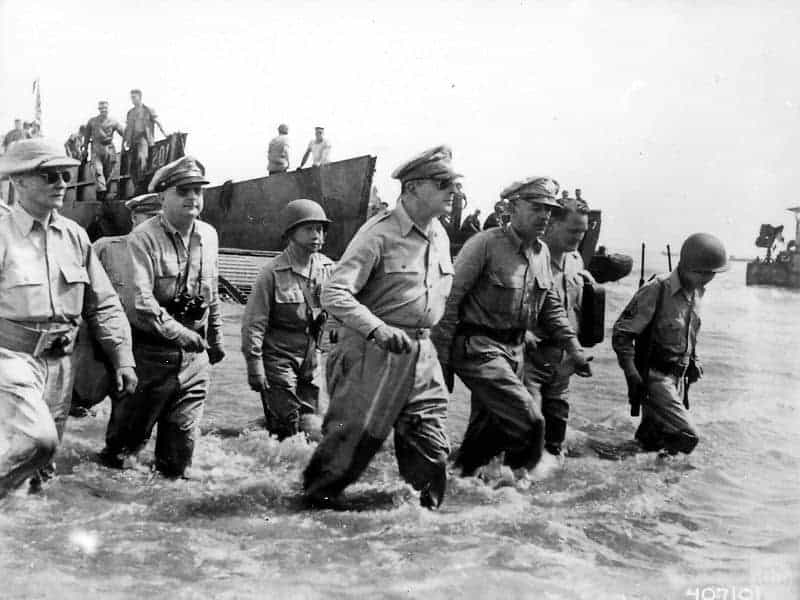
14. The battle raged on in the Philippines after MacArthur was withdrawn

The Filipino and American troops on Bataan fought on for months in the Philippines, supported by the Navy and the remnants of the air forces, winning some victories as they withdrew. Japanese casualties were heavy. The fighting was indicative that had they been better positioned and led at the onset they may have been able to hold at least part of the archipelago. But it was not to be. In March 1942, MacArthur was ordered to leave Corregidor and remove himself to Australia. He was evacuated by PT-Boat with his family in a daring move and taken to Mindanao, from whence he flew to Australia. It was from there he made a speech in which he said, “I came through and I shall return”.
He was asked to alter the speech to say, “We came through and we shall return”. He refused. It was typical MacArthur. George Marshall then recommended MacArthur for the Medal of Honor. Eisenhower pointed out the requirement for an act of valor, which MacArthur had not performed. Marshall used the precedent of Charles Lindbergh receiving the award in 1927, which had required special legislation by Congress (and which led to the award being mistakenly called the Congressional Medal of Honor). His citation claimed a “tremendous superiority of enemy forces in men”, which was untrue. In 1945 the Adjutant General reviewed MacArthur’s award of the Medal of Honor, and called it “questionable”.


