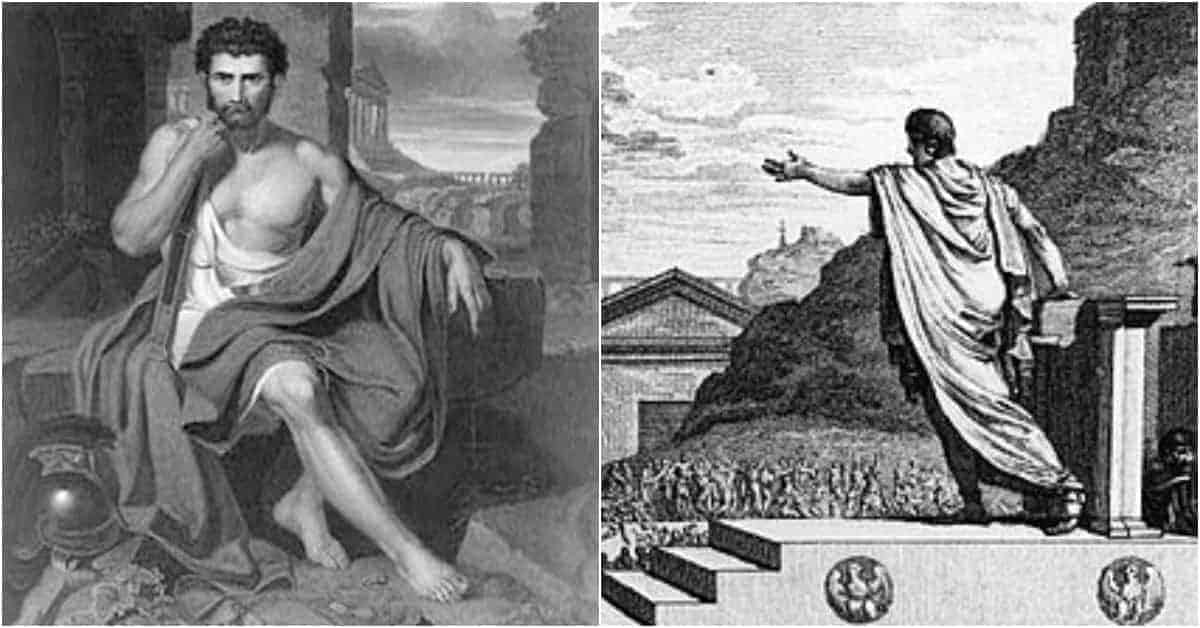

Cicero
Marcus Tullius Cicero (106 – 43 BC), considered Rome’s greatest orator, was a statesman, scholar, lawyer, and writer who served as consul in 63 BC. Throughout his career, he tried in vain to uphold republican principles as the Roman Republic tore itself apart in civil wars during its final years. He had much greater impact and success influencing Western thought for centuries, and the rediscovery of his writings more than a millennium after his death is credited with sparking the Renaissance.
Cicero was born into a wealthy equestrian family in Arpinum and was sent to study law in Rome as a youth. His brilliant defense of a Sextus Roscius in 79 BC against trumped-up charges of parricide established his reputation as a lawyer and began his rise in Rome. He became a supporter of Pompey the Great, and as a member of the conservative and pro-aristocratic optimates faction, was elected consul in 63 BC. That year, he suppressed what came to be known as the Catiline Conspiracy to overthrow the government, arresting and ordering the summary execution of its ringleaders captured in Rome.
In 60 BC, he declined an invitation to join Caesar, Pompey, and Crassus in what became known as the First Triumvirate, deeming the arrangement unconstitutional, and doing all he could to undo it by driving wedges between the Triumvirs. Crassus was killed in battle in 53 BC, and when Pompey and Caesar fell out and the latter marched on Italy in 49 BC, Cicero sat out the ensuing civil war, and spent that period in scholarly pursuits and writing books and treatises.
After Caesar’s assassination in 44 BC, Cicero promoted the cause of Gaius Octavius, Caesar’s adopted son and heir, seeking to use the teenager as a cat’s paw during his conflict against Mark Antony, whom Cicero loathed and against whom he penned and orated scathing critiques known as The Philippics. Quipping that he would “praise, raise, and erase” Octavius, Cicero greatly underestimated the youth, who as the future Augustus would end the Roman Republic and replace it with the Roman Empire. Octavius shrewdly reconciled with Mark Antony and cut a deal that divided Rome between the two, who then proceeded to clean house by eliminating all enemies, and potential opponents of the regime in a bloody purge that outdid Sulla’s. Cicero, as an avowed enemy of Mark Antony, was on the new regime’s list of the proscribed.
He fled Rome, but was captured and killed on December 7th, 43 BC. A vindictive Antony then had Cicero’s severed head and hands displayed in the rostra, or speaker’s platform in Rome’s Forum, after Antony’s equally vindictive wife pierced the orator’s tongue with knitting needles.
Defeated politically, Cicero triumphed intellectually. His impact extended far beyond his own days, as he left behind a trove of writings on philosophy, politics, rhetoric, and oratory, whose rediscovery in the 13th century and the keen interest they aroused in scholars, amongst whom Petrarch was most notable, helped jump-start the Renaissance. He influenced European literature and ideas more than any single prose writer before or since, and his impact on the Latin language was such that until the 19th century, all European prose could be viewed as being a return to or a reaction against Cicero’s style.


