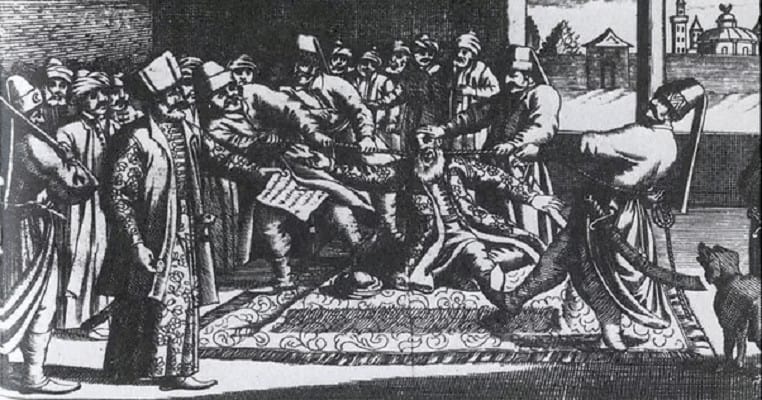
36. The Ottoman Sultans’ “Humane” Alternative to Murdering Their Brothers

Ottoman Sultan Mehmed II’s successors usually heeded his advice to maintain the stability of the realm by preemptively executing their brothers upon ascending the throne. It was a cruel expedient, but it worked: for the next two centuries, the Ottoman Empire was remarkably stable and free of infighting and civil wars when compared to its contemporaries. However, although the system worked, the consciences of many throughout the realm were bothered by the murder of innocent royal siblings at the start of each reign. Those misgivings reached a peak when Sultan Mehmed III (reigned 1595 – 1603) inaugurated his reign by ordering his 19 brothers, some of them mere infants, strangled to death. It was said that “the Empire wept” as a long line of child-sized coffins exited the palace in a grand procession the next day.
Eventually, a reaction set in against that tradition of fratricide, and a new tradition was developed to take its place: instead of new Sultans outright murdering their siblings upon ascending the throne, they simply locked them up. Thus was born the system of the Ottoman Kafes, or “Cage”, whereby Sultans set up a secluded part of their royal Harem as a detention center for their brothers. There, potential rivals to the throne were kept under house arrest, under surveillance by palace guards and isolated from the outside world to prevent intrigues and plots. As seen below, life in the Kafes could be rough, but for those living in it, the very fact that they were still living at all meant that it (usually) beat the alternative.


