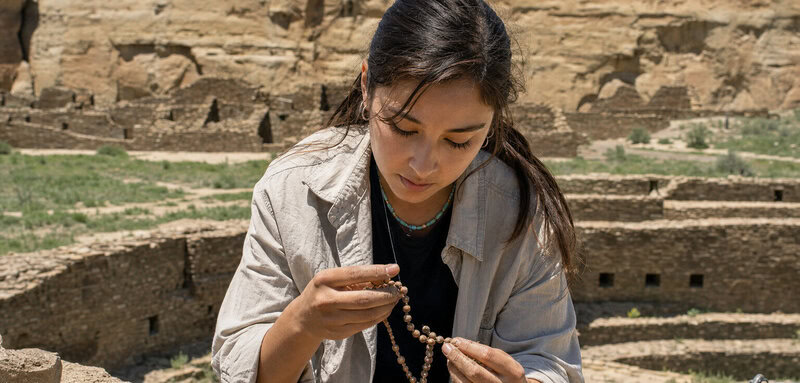
She almost missed it. The brush was moving on its usual rhythm — short strokes, careful angle, eyes down — when the soil gave up something that had no business surviving centuries of freeze and thaw and the slow crush of collapsing adobe: a rosary, intact, its beads still strung, resting inside a wall that hadn’t seen daylight since long before anyone alive could remember.
The Rosary in the Rubble
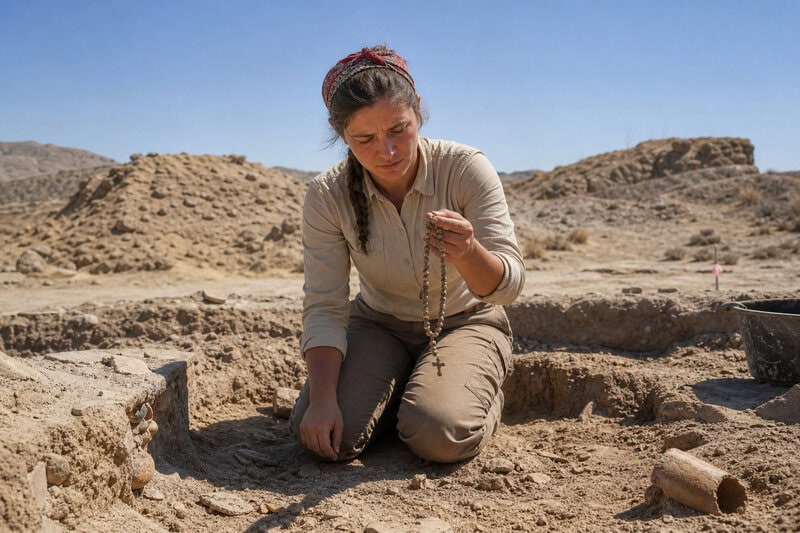
When a University of New Mexico field school student kneeling in the New Mexico dust pulled that string of beads from the eroded remains of an adobe wall, the dig stopped. It had to. A devotional object, intimate in scale, impossibly preserved — the kind of find that collapses centuries in an instant and forces a question no field manual can fully answer: whose hands last held this, and what were they praying for amid these collapsing rooms?
That rosary is not an isolated miracle of preservation. It is a symptom of something larger and more unsettling, at least for anyone who prefers their history tidy. UNM students excavating sites across New Mexico have been turning up objects and architectural evidence that keep refusing to fit the clean story textbooks tell about pre-Columbian and early colonial life in the American Southwest. Adobe walls still bearing the impressions of the hands that shaped them. Stone foundations laid without mortar that have outlasted the civilizations that built them. An altar area that announced itself not with a placard but with nothing more than a change in soil color and the quiet clustering of objects around a prepared surface.
What follows covers one season of that work — from an ancient field house near Placitas to the monumental silence of Chaco Canyon — and the question it keeps posing: what exactly do we think we know, and why does the dirt keep proving us wrong?
What a Field School Actually Looks Like
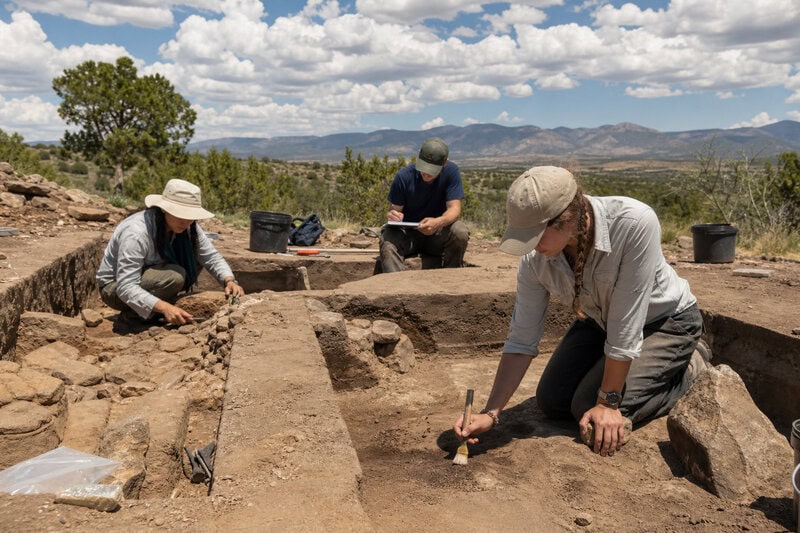
Forget the Hollywood image: no one is leaping into a stone chamber ahead of a rolling boulder. University of New Mexico archaeology field schools are slow, meticulous, and physically demanding in the most unglamorous way imaginable — stratigraphic recording in the full force of a New Mexico summer, soil screening in the shade of a tarp, paperwork that must be completed before the light fails. The romance, to the extent it exists, is deferred.
What students get instead is something more valuable: real contexts. Not simulated lab exercises, but actual adobe wall stubs, stone foundations, and ash lenses that carry genuine archaeological consequence. Learning to dig at a UNM field school means learning by doing, under the supervision of professional archaeologists who understand that every shovel pass through an unexcavated context is a one-time event. There is no undo button in stratigraphy.
The communal rhythm of a dig is itself part of the education. The person kneeling beside a student in the trench might be a tribal historic preservation officer, a PhD candidate, or a veteran field archaeologist whose site reports span decades. That range of expertise and perspective — compressed into a shared workspace no larger than a few square meters — is a curriculum that no classroom can replicate.
Consider what it takes to excavate an altar area. Nothing announces itself. There is no sign reading “ritual space.” Instead, a student must learn to read the evidence simultaneously from multiple registers: the deliberate preparation of a surface, its spatial orientation within the larger structure, the compaction of soil that suggests repeated foot traffic, the quiet clustering of objects that were placed rather than discarded. Miss any single thread and the interpretation unravels. The student who found the rosary had learned, by the time the beads emerged, to stop and read the room — or what remained of it.
Placitas and the Field House That Shouldn’t Be There
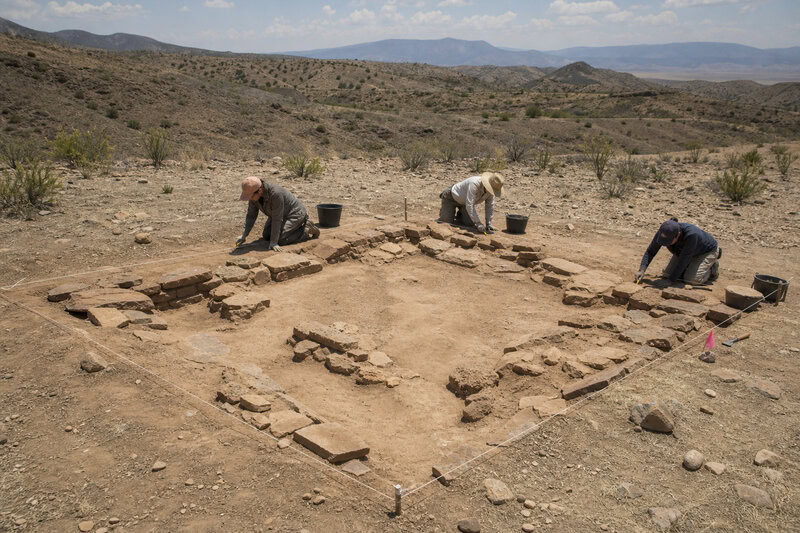
Some discoveries announce themselves dramatically. Others arrive as a modest rectangle of sandstone foundations barely visible at the surface of a slope that previous surveys had mapped as essentially empty. The ancient pueblo field house unearthed during a UNM field school near Placitas, New Mexico, was the second kind — and it turned out to matter considerably more than its size suggested.
Field houses are the connective tissue of Pueblo economic life: single-room or small-cluster structures positioned to support agricultural activity, seasonal habitation, and storage at a remove from the larger villages. For decades, archaeological focus in New Mexico tended to concentrate on great houses and major pueblo centers, treating the terrain between them as incidental. What field school excavations at sites like Placitas are gradually revealing is that the terrain was not empty. It was managed, populated, and productive — a distributed civilization rather than a nucleated one, its infrastructure scattered across the landscape in structures modest enough to be overlooked.
The stone foundations at sites like this carry a quiet precision that students must learn to recognize before they can excavate without destroying it. Courses of sandstone laid without mortar in patterns engineered to survive centuries of freeze-thaw cycles — a construction logic that is entirely legible once you know how to read it, and entirely invisible until you do. Getting it wrong means lifting a stone that was placed with intention and treating it as rubble.
And then there is the adobe. Mud brick is not the most durable building material, which makes it all the more remarkable what survives inside the sections that do persist: fingerprints pressed into walls by the people who built them, tool marks, the negative impressions of organic material — timber, basketry, plant fiber — long since rotted away. Each impression is a negative space where a life once pressed. The Placitas field house produced adobe wall sections that carried exactly these kinds of traces, turning what might have been a footnote into an archive.
The Haynie Site: Two Structures, Many Stories
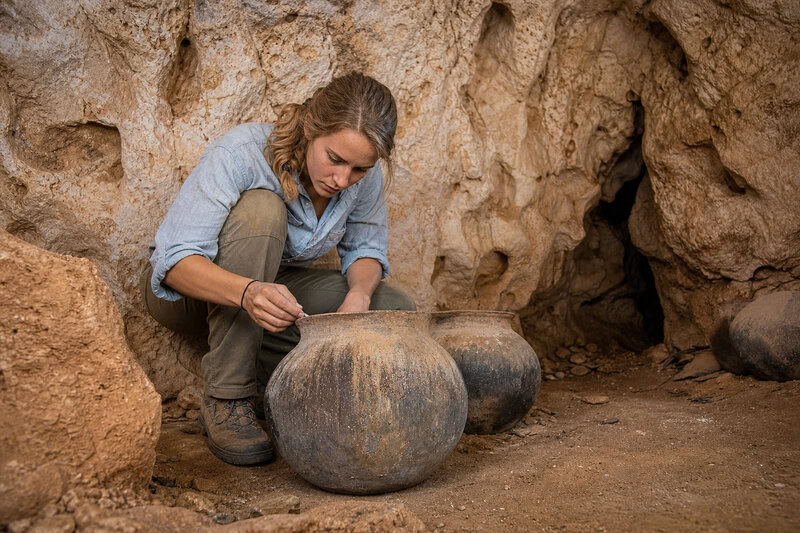
Time, weather, and the patient work of erosion have reduced the Haynie site to two legible structures. But “legible” is doing considerable heavy lifting in that sentence. Every layer of fill inside those rooms contains a compressed archive of habitation, abandonment, reuse, and decay — a stratigraphy that rewards patience and punishes assumptions.
The altar area uncovered at Haynie is the site’s most charged feature. Architectural spaces set aside for ritual use indicate a community organized around shared ceremony, not just subsistence. This matters for how indigenous history in the American Southwest gets told. The materialist shorthand that sometimes reduces ancestral Pueblo life to a story purely about food storage and drought response misses something fundamental about the communities that built these places — something that a deliberately prepared ritual surface, positioned with evident intention within a small ancestral Pueblo village, makes difficult to ignore.
Students at the Haynie site conduct fieldwork alongside archaeological professionals whose relationships with descendant Pueblo communities shape which questions get asked and how finds are handled. This is not incidental to the methodology — it is the methodology. The ethical dimension of Southwest archaeological fieldwork has evolved significantly over recent decades, and a field school student working at Haynie encounters that evolution directly, in the form of colleagues whose expertise is not only technical but relational.
The two-structure footprint of Haynie is itself a data point. Small sites aggregate into settlement patterns, and it is the patient cross-referencing of dozens of modest excavations — many conducted by field school cohorts across successive seasons — that lets researchers map how Pueblo populations moved, merged, and reorganized across centuries. No single dig tells that story. The cumulative record does.
Chaco Canyon: Where Every Stone Is an Argument
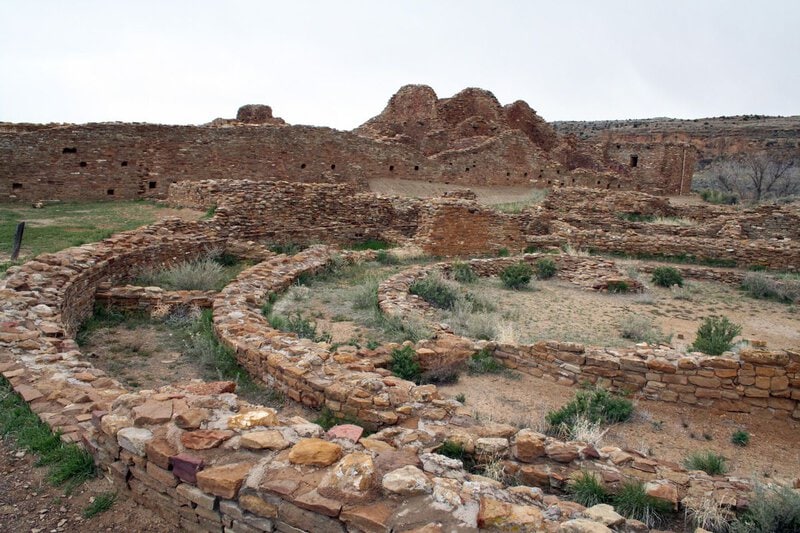
Then there is Chaco.
The canyon arrives in the consciousness of a field school student like a change in atmospheric pressure — something shifts before you can entirely explain why. Great house walls that stand four stories in places, built from millions of carefully shaped sandstone pieces fitted together with a precision that still generates legitimate debate among structural engineers. Roads that extend the canyon’s influence hundreds of miles in every direction, connecting outlier communities to a center whose exact function remains, after more than a century of professional excavation, genuinely contested.
UNM has conducted archaeological field schools at Chaco Canyon in partnership with the School of American Research, and the canyon rewards that sustained attention precisely because it refuses easy answers. Was Chaco a pilgrimage center? A redistribution hub? An elite enclave? A cosmological monument aligned to lunar cycles? The debates are not academic vanity — they reflect genuine interpretive uncertainty that new stratigraphic data, including data gathered by student cohorts, continues to push in different directions. Archaeology at Chaco is not the recovery of a known past. It is an active argument.
UNM’s 2026 Southwest Archaeology Field School will take place at Chaco Canyon National Historical Park from May 29 to July 10, adding another cohort to that cumulative interpretive record. For students who began their fieldwork reading the modest logic of a Placitas field house, Chaco presents the same distributed intelligence at monumental scale — the great houses inseparable from the small sites, roads, and outliers that give them meaning. Pre-Columbian ruins in New Mexico reach their most visited and most debated expression here, making it an ideal capstone for a field school that wants students to understand not just how to excavate, but what is at stake in every layer they open.
Indigenous Voices and the Limits of the Trowel
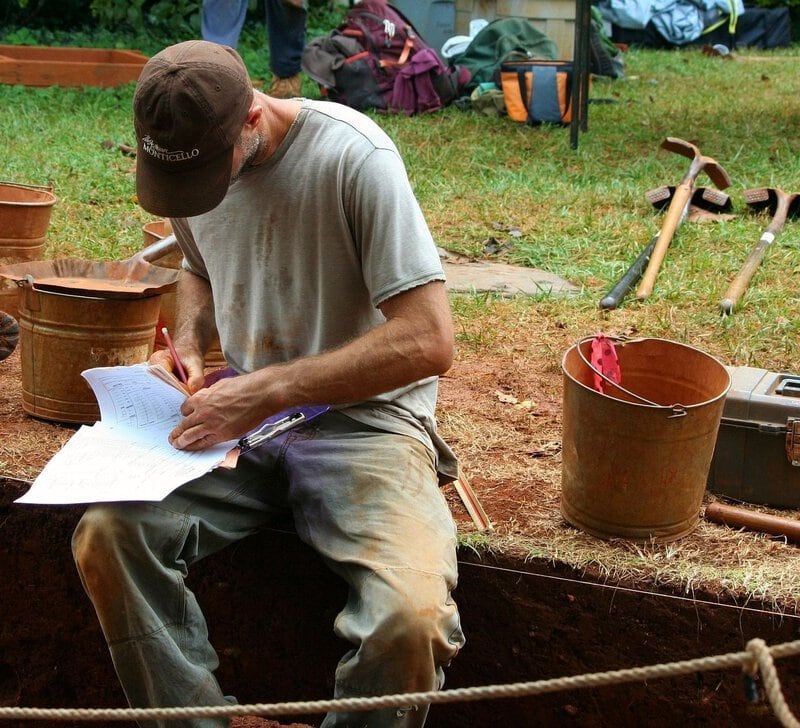
The most significant shift in University of New Mexico archaeology over recent decades is not a new dating technique or a refined excavation method. It is relational. Descendant communities — Pueblo peoples whose ancestors built every site students excavate — are now partners in research design, not subjects of it. That change in posture has altered not just the ethics of the work but its content.
Partnership shapes what gets published and what gets reburied. It shapes which questions are considered worth asking. The rosary, the altar space, the field house near Placitas — each object carries a chain of custody that extends forward to living communities, not just backward into stratigraphy. A field school student who handles these objects encounters that chain directly, often in the form of a tribal historic preservation officer standing in the same trench, whose knowledge of the site’s significance runs through oral tradition as well as soil profiles.
Some of the most consequential recent reinterpretations of Pueblo prehistory have come not from new finds at all, but from reanalyzing existing collections through frameworks co-developed with Pueblo scholars. The archive is never closed. The questions it can answer depend entirely on who is allowed to ask them — which is, when you think about it, true of most archives worth consulting.
Field schools sustain the slow, broad-coverage excavation that large grant-funded projects cannot always prioritize. The cumulative modest dig — a field house here, a two-room village there, a rosary emerging from a wall that collapsed before anyone living was born — is precisely how regional patterns emerge from what would otherwise be isolated data points. Student discoveries contribute to this ongoing negotiation in ways that are easy to undervalue but impossible, over time, to ignore.
What the Next Dig Will Find
The afternoon light goes amber over the canyon rim. The rosary has been photographed, measured, described in a site form, and placed in an acid-free bag. The student who found it is filling out paperwork in the shade — which is, as it turns out, where most of archaeology actually happens.
But the question the rosary poses has not been filed away with it. Whose hands last held this? What community did they belong to, and what did that community understand about itself that the people excavating its walls do not yet know? Southwest archaeological fieldwork has been asking versions of that question for more than a century, and the dirt keeps providing answers that require the question to be revised.
The 2026 Chaco field school will add another cohort of students to that long, patient, cumulative inquiry. They will leave knowing how to read a soil profile. They will leave knowing — perhaps more importantly — that every site they touch belongs to a living history that extends well beyond the walls of any university. And some of them will have held objects that collapse the distance between past and present in ways that no lecture can fully prepare you for.
A rosary pulled from an adobe wall is not a mystery solved. It is a question posed — about faith, about survival, about the people who built these rooms and the people who are only now learning to read them. The best answer Southwest archaeological fieldwork has produced, after all these careful seasons in the dust, is to keep digging slowly, keep listening to the communities whose ancestors did the building, and keep revising, without embarrassment, what we thought we knew.