1. Constantine VI Might Have Had History’s Meanest Mommy

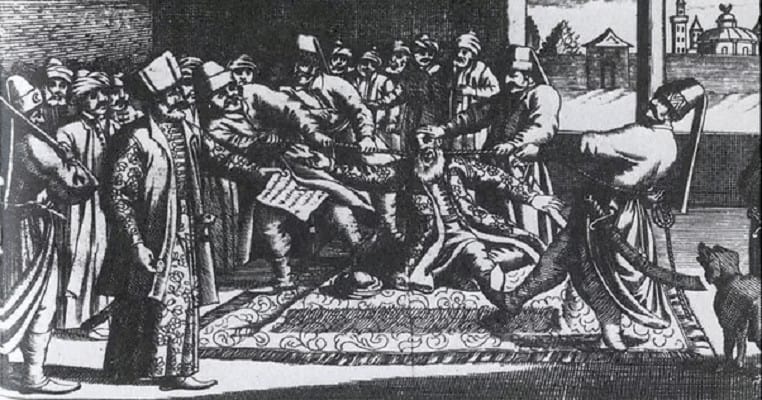
Byzantine emperor Constantine VI (771 – died before 805) ascended the throne as a child, following the death of his father Leo IV in 780. Since Constantine was only nine years when he was crowned, his mother, empress Irene, ruled in his place as regent. At the time, the empire was roiled by nasty conflict known as Iconoclasm, between those who viewed the veneration of religious icons as idolatry (Iconoclasts), and those who were OK with icons (Iconodules). In the preceding decades, Iconoclasts had held the upper hand, and, icons were banned throughout the Empire. Irene was an Iconodule, however, and after consolidating her power, she set about undoing the preceding decades of Iconoclasm with all the tenacity and enthusiasm of a religious zealot. In her determination to let nothing stand in the way of her religious mission, Irene rode roughshod over the Iconoclasts – including her own son.
Irene began by calling a called church council in 786, and packed it with opponents of Iconoclasm. Unsurprisingly, the council concluded that Iconoclasm had been a huge mistake. That kicked off a Byzantine counter-reformation against the Iconoclasts, who resisted the return of religious imagery just as vehemently as their opponents had resisted the destruction of icons. When Constantine VI finally came of age, he declared himself an Iconoclast. Irene demonstrated the strength of her faith by overthrowing him, and in 797, she staged a coup that deposed Constantine, and put her on the throne in his place. She then ordered her son’s mutilation by gouging out his eyes. Constantine was maimed so severely, that he died of his wounds soon thereafter. Irene then proclaimed herself empress and continued her quest to undo Iconoclasm and reintroduce religious imagery.
_________________
Where Did We Find This Stuff? Some Sources and Further Reading
Ancient History Encyclopedia – Attila the Hun
Ancient History Encyclopedia – Caracalla
Badass of the Week – Fredegund
Castor, Helen – She Wolves: The Women Who Ruled England Before Elizabeth (2011)
Catholic Answers – It Is Better to Be Herod’s Pig Than Son
Clements, Jonathan – The First Emperor of China (2006)
Crown Chronicles – History’s Strangest Deaths: The Duke of Clarence Drowned in a Barrel of Wine
Daily Sabah, August 6th, 2015 – The History of Fratricide in the Ottoman Empire
Cassius Dio – World History Encyclopedia
Encyclopedia Britannica – Valeria Messalina
Encyclopedia Britannica – Wuhou
Gloria Romanorum – Constantine’s Execution of Crispus and Fausta
Gonick, Larry – The Cartoon History of the Universe: From The Big Bang to Alexander the Great (1990)
Hildinger, Erik – Warriors of the Steppe: Military History of Central Asia, 500 BC to 1700 AD (1997)
History Today – The Murder of Darnley
JSTOR – The Fall of Julia the Younger
Kinross, Lord – The Ottoman Centuries: The Rise and Fall of the Turkish Empire (1977)
Massie, Peter K. – Peter the Great: His Life and World (1980)
Spiegel, October 9th, 2009 – Murder in Hitler’s Bunker: Who Really Poisoned the Goebbels Children?
Suetonius – The Twelve Caesars (2013)


