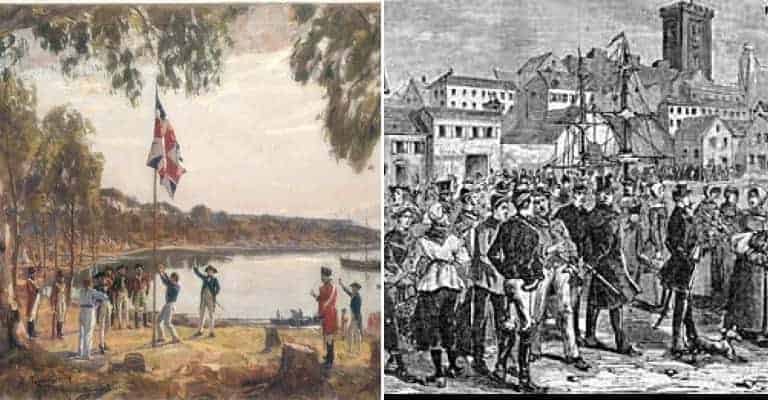

7- At first, convict transportation to Australia was very slow indeed
“My Dear Wife belive me my Hark is almost broken to think I must lave you behind. O my dear what shall I do i am all Most destracted at the thoughts of parting from you whom I do love so dear. Believe me My Dear it Cuts me even to the hart and my dear Wife there is a ship Come into Portsmouth harber to take us to New Southweals.” Peter Withers, a convict, writing to his wife in 1831
It was always the idea that Australia, once established, would be the dumping ground for all those excess prisoners that the British jails could not hold. The prison hulks that floated off the major cities, however, barely emptied over the first 15 years of the colony in New South Wales. “There was no year from 1801 to 1813 in which more than five convict transports anchored in Sydney,” wrote Robert Hughes in The Fatal Shore, his seminal history of convict transportation to Australia, “and not until 1814 would as many as a thousand convicts arrive in a single year.”
The First Fleet begat the Second and the Third and so on, but it was a trickle rather than the flood. Why, if the colony had been established and desperately needed manpower to keep it going, was the flow so slow? There was a surfeit of potential prisoners and it was being added to by the day – the harsh laws in England certainly hadn’t changed. What held the tide back was a change of opinion at home and a drastic realignment of priorities.
In 1787, when the First Fleet departed Portsmouth, Britain was enjoying a rare period of peace. The American Revolution had ended – prompting the need for a new destination for convicts in the first place – and there were no foreign wars drawing valuable resources from the British Exchequer. There had been prolonged conflicts with the French and the Dutch, which had taken place both in Europe and in the East Indies, but these were now settled, for the meantime at least. Thus, time and money could be dedicated to solving the problem of law and order at home.
By the time of the Third Fleet, however, that had all changed. The French Revolution had overthrown the old order and the delicate balance of power in Europe, and suddenly the potential for a new war close to home skyrocketed. When war finally did break out with France in 1792, the convicts that might have been slated for a trip to Australia were repurposed, either as fodder for the Army or as indentured labourers on the docks and in the harbours, returning to the hulks at night.
Moreover, a vital aspect of shipping convicts to Australia was a provision of soldiers to guard them and medical personnel to ensure that they were in a fit state when they arrived. With war against the revolutionaries in France, an uprising in Ireland in 1798, fighting between the newly independent Americans and the British forces in Canada in North America and a whole colonial empire to maintain in India and Africa, there was little purpose to be found in funding the exportation of potential labourers. Australia would have to wait.
For many of those who were already in Australia, however, the time of their service was coming to an end. Most had sentences of seven years which, from the mid-1790s, began to expire. They had the option to leave and return back to England, of course, but rarely had the funds to do so and even less inclination. This new land presented opportunities that were unachievable at home: endless expanses of land that they could occupy and own, free from the stigma of being a criminal – or at least, being surrounded by other emancipated criminals who didn’t mind as much.
It would be on the backs of these Emancipated convicts that the colony would grow. They would remain, however, marked with the whiff of criminality and the new Australia would have to deal with it. After all, they couldn’t all be merely political prisoners…


