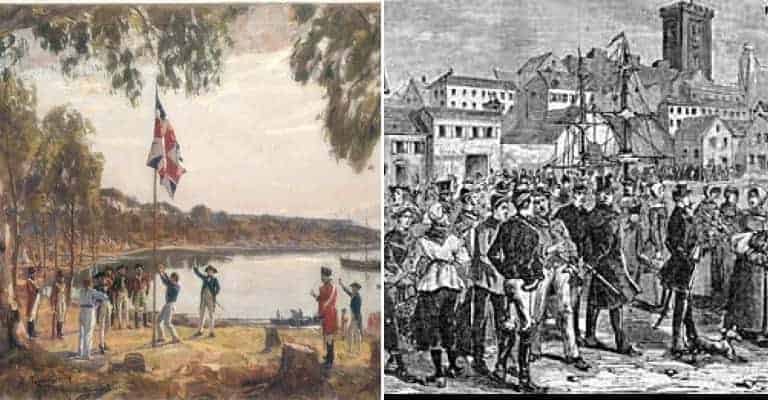

6- The Second Fleet nearly killed the First Fleet
“The sending out of the disordered and helpless, clears the gaols and may ease the parishes from which they are sent; but…it is obvious that the settlement, instead of being a colony which will support itself, will, if this practice is continued, remain for years a burthen to the mother-country.” Captain Arthur Phillip, Governor of New South Wales
It can get lost in the stories of the early life of the New South Wales colony that the First Fleet was arguably the most successful maritime mission ever made. Most talk of the journey – this article included – focusses on the conditions that made Australia a viable location, or the impact of the British when they arrive, but the passage from Portsmouth to Botany Bay was a minor miracle of seamanship.
It is not known exactly how many people died en route, but the general consensus is that the number was low, around 3% of the between 1,000 and 1,500 that made the journey. That sounds like a lot, but for the time it was considered quite exceptional, especially given the poor health and advanced age of some of those who made the trip. Indeed, it would be one of the most successful in terms of death rate of any of the convict transportations that followed.
The same, unfortunately, could not be said for the Second Fleet. The first convict transport had been engaged by the Crown directly with the intention of keeping as many men alive as possible so as to adequately establish and build the colony. Thus, healthy food and regular exercise had been prioritised by Captain Phillips. This goal achieved, the British government decided to subcontract the Second Fleet, intended to bolster the numbers in New South Wales and provide a boost in supplies, to a company named Camden, Calvert & King, who were to be paid a flat fee per convict, regardless of whether they arrived in Australia alive.
Camden and Calvert scrimped and saved on everything, with little oversight from their government paymasters. The ships were converted slave galleons, more used the passage from Africa to America, and their conditions were dire. “It was impossible for them to move but at the risk of both their legs being broken,” wrote a New South Wales corps soldier guarding prisoners on one of the ships, while a convict later recalled “When any of our comrades that were chained to us died, we kept it a secret as long as we could for the smell of the dead body, in order to get their allowance of provision, and many a time have I been glad to eat the poultice that was put to my leg for perfect hunger. I was chained to Humphrey Davies who died when we were about half way, and I lay beside his corpse about a week and got his allowance.”
Hunger and disease were rife and the Second Fleet turned out to be the worst voyage in the entire history of penal transportation to Australia. Hundreds had died en route and of those who survived, almost half were so ill that they could not work. The whole Sydney Cove colony had been precipitated on the idea that help was coming to relieve them, that they would lay the groundwork and then be resupplied from the motherland with able-bodied men and provisions. Instead, they were nearly extinguished by the weight of sick and dying men that their fledgeling community could barely sustain.
Sustain them they did, however, and soon a Third Fleet was underway. A fourth would follow, and a fifth, until the small colony looked more and more like the Australia that we know today.
There was a hitch, however, with the penal transportation system: Britain soon had far bigger fish to fry closer to home…


