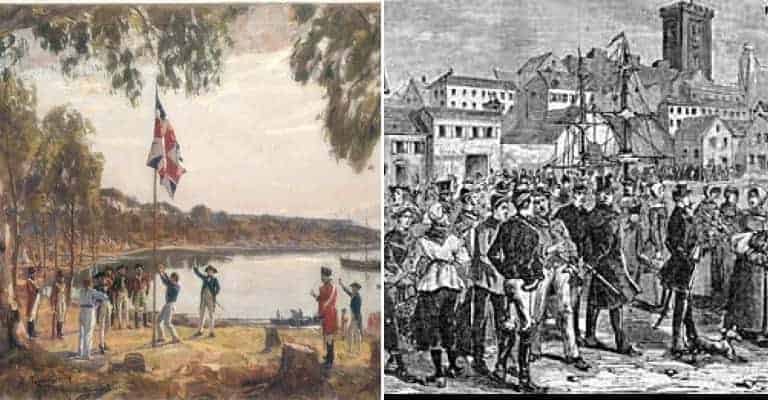

3 – Britain saw Australia as a dumping ground for its worst citizens
“The “thief-colony” was indeed a measure of experiment…but the subject-matter of experiment was, in this case, a peculiarly commodious one; a set of animae viles, a sort of excrementitious mass, that could be projected, and accordingly was projected—projected, and as it should seem purposely—as far out of sight as possible” Jeremy Bentham
It isn’t an unreasonable question, given the current mores on justice and prisons, to wonder why the British authorities of the 18th-century saw fit to execute and transport so many of its citizens. After all, at the time that Australia was first envisaged as a permanent place of banishment, the Walnut Street Prison, later to become the Eastern State Penitentiary, was being opened in Philadelphia as the first modern prison, with a philosophy that focussed as much on rehabilitation and repentance as punishment.
The forward-thinking colonists in America might have embraced the new idea of the penitentiary, but back in the old country, the prison was – like it had been since time immemorial – a holding cell that sequestered the criminal from society. The prevailing ideology of the time was not that acts were criminal per se, but that there was a criminal class, who were predisposed towards crime and always would be. This encapsulated everyone from prostitutes on street corners and petty thieves to master forgers, dashing highwaymen and political dissidents. This was, as Edmund Burke put it, the “swinish multitude”.
It was the origins of the great working class that would form in the middle of the 19th century, but in this period, was more embryonic. Without regular factory work, people scraped to get by and, for those in power and the upper classes, it was difficult to see what they did. Thousands of irregular trades existed, many of them on the borderlines of legality, many of them barely providing enough income for sustenance and many of them leading to chronic illnesses in later life. Criminal might as well have been a synonym for poor.
When the rich of the time spoke of the “criminal classes”, they saw them as unreformable. Certainly, the common thinking of the time was that punishments should be harsh, so as to act as a deterrent, and permanent, so any criminal would be forever marked as such. Execution was obviously both harsh and permanent, but beneath that were other options. Criminals were imprisoned in private jails, which made money based on how many prisoners they held and then by extorting those in captivity. Prisoners had to pay for their irons to be loosened, for their food, their access to exercise and light and their bedding. There was no sex segregation, no segregation by age and no heed paid to offence.
Prison reformer John Howard wrote:
“The prisoners have neither tools nor materials of any kind but spend their time in sloth, profaneness and debauchery…Some keepers of these houses, who have represented to magistrates the wants of their prisoners, and desired for them necessary food, have been silenced with the inconsiderate words, Let them work or starve. When these gentlemen know the former is impossible, do they not by that sentence inevitably doom poor creatures to the latter?
When everyone agreed on the permanence of criminality among the populace, then it became logical to send these prisoners to a permanent prison, where, even at their end of their sentence, they would be so far away as to never be able to re-offend. Or at least, if they did re-offend, they would be so far away that it wouldn’t matter. Thus was the viability of penal transportation established.
There was a class of criminals that needed a holding cell so big that an inexhaustible number could be sent. There was a huge land, about which nobody knew almost anything, to which no settler would go by choice, but was there to be colonised. The logic of Australia was easy to see.
The problem, of course, was the people that were already there. The Aborigines, the original Australians, about whom we will talk on the next page.


