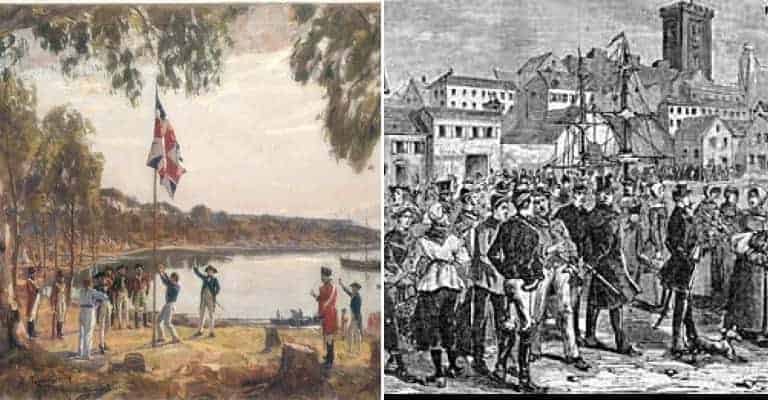

8 – Contrary to the beliefs of most Australians, very few convicts were political prisoners
“You will make our children read, and get off, the above Scripture passages. Never let them read any political works. Keep their minds from being entangled with political men, and their productions. This, you will not need to be told, has been the prelude to all my present misery” An unknown convict and former Swing Rioter, writing to his wife in 1835
One the many ways in which modern Australia has come to deal with its convict past is a pervading myth that many of the prisoners were political dissidents, rebels sent from the motherland to forge their own new society. It suits the idea of the larrikin, devil may care Aussie battler, always poking at authority and striving for the endless freedom of the bush. The problem with that idea, of course, is that it is nonsense.
The vast majority of convicts fell into a fairly specific legal subgroup, created by the British state’s aforementioned obsession with the defence of property. They were not big time criminals – anyone who stole anything over the value of 5 shillings would end up on the scaffold rather than a prison ship – nor were they generally violent offenders. One of the useful things about studying a society of convicts is that court records are available to tell historians exactly who these people were, where they came from and what they had done to merit transportation. Those records tell us at almost 80% were convicted for petty theft and 66% had prior convictions. They were generally urban, young, single, male and overwhelmingly propertyless, landless labourers. In short, they were the proto-working class.
The low-end estimate of the number of political prisoners sent to Australia is around 1800 in total in the 60 year period of transportation. There were economic activists, such as the Swing Rioters and Luddites who destroyed industrial machinery in defence of their jobs. There were political activists, most famously the Tolpuddle Martyrs, sent to Botany Bay in 1834 for attempting to form trade unions, as well as Chartists who campaigned for the right to vote and members of the Pentrich Rising, who had taken arms against the state in Derbyshire in 1817.
While these rag-tag band of rebels were statistically unimportant in the wider scale of penal transportation, there is perhaps, one unintended consequence of Britain’s scheme to deport its urban poor. The revolution that spurred in France at the same time as the fledgeling New South Wales colony was taking root in Australia was, to a large extent, the work of a class of people known as the “san-culottes“. These were the urban, underemployed, neglected youth of the big cities, the first to join the demonstration and the spiritual driving force behind the radicalism.
While the British could never have known what events were to take place over the water in Paris, they inadvertently took a huge step towards limiting the potentiality of any similar uprising taking place on their own shores by instituting a system by which the most radical and revolutionary figures from the lower classes could simply be picked up and dropped off on the other side of the world, never to trouble the authorities again. Many of those who were transported were not political activists, but they were certainly exactly the sort of people were likely to join in any demonstration against the established order that sprung up. They were the potential san-culottes.
There was, of course, one group of convicts that were already very ill-disposed towards the British. They provided the bulk of the political prisoners that were sent to Australia, while also creating an underclass even within the ranks of the convicts. They were the Irish.


