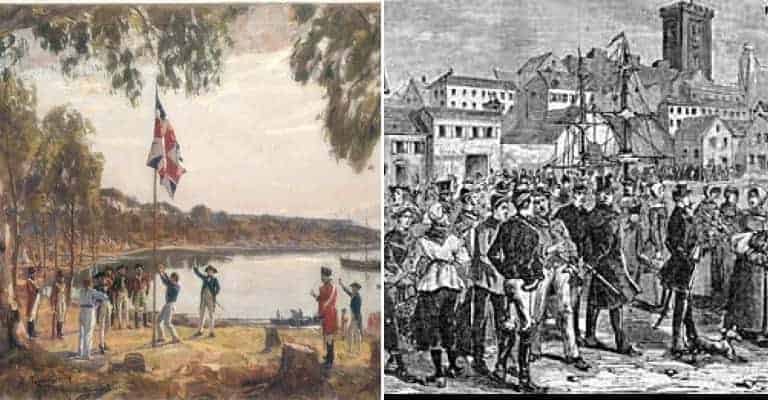

4 – The genocide of Indigenous Australians did not begin straight away – in fact, relations were quite good
“From what I have said of the Natives of New-Holland they may appear to some to be the most wretched people upon Earth, but in reality they are far more happier than we Europeans; being wholly unacquainted not only with the superfluous but the necessary Conveniences so much sought after in Europe, they are happy in not knowing the use of them. They live in Tranquility which is not disturbed by the Inequality of Condition” Captain James Cook
The idea of Australia Day is heavily contested in Australia by the original inhabitants of the land. It is known to many as Invasion Day, synonymous with the beginning of the genocide of Aboriginal people by Europeans. Words should not be minced on the issue: it was a genocide, in which whole cultural groups that had existed for thousands of years were wiped off the map, whether deliberately through the violence of colonisation or through imported diseases to which the native people had no immunity. Common estimates hold that at least 100,000 people were killed in the conquest of Australia, but the number is far, far larger and in truth, nobody on the British side was counting.
Captain Cook sighted Aborigines when he first sighted Australia. On the landing at Botany Bay, they had attempted to make contact but most of the tribe fled, while two remained to throw spears at them. Cook shot one in the arm and the two retreated. Cook and his men landed on the beach and entered a small hut, in which they found Aboriginal children and left them beads as a present. Back in London, however, he told his superiors that the native Australians would put up no real resistance, unlike the Maori in New Zealand.
When the First Fleet arrived at Botany Bay, they arrived with specific instructions that the natives they encountered should not be harmed. The orders given to Captain Phillips read:
“You are to endeavour by every possible means to open an Intercourse with the Natives and to conciliate their affections, enjoining all Our Subjects to live in amity and kindness with them. And if any of Our Subjects shall wantonly destroy them, or give them any unnecessary Interruption in the exercise of their several occupations.”
Conflict was inevitable – the British had just invaded the local tribe, the Iora’s, land – and yet Phillips ordered that restraint be shown. Some of the convicts were prosecuted for stealing from Aborigines, who were wont to leaving their tools lying around. After all, there had previously been nobody to steal them, let alone a band of convicts of whom 80% had prior convictions for theft. The convicts, less bound by the laws of the Navy, resented the natives yet more: they represented the walls of this new prison, a malevolent force keeping them within the confines of the colony, as well as a group that they saw as savages but whom their captors seemed to value more than them. Even when Aborigines killed convicts, revenge against them was forbidden.
Alas, it would not last. As the colony expanded, the parameters of Aboriginal land were rolled back as the British frontier extended. The first wars began in 1795 as the British advanced into the Blue Mountains behind Sydney and spread wherever the colonists went. No treaties were signed with the tribes and eventually, they were stripped of all rights.
It would take over a century for Indigenous Australians to gain the rights afforded to White Australians and indeed, their numbers were not even counted in many areas. It would not be until the mid-1990s that their numbers would reach pre-colonisation levels again.
With the colonists in the ascendancy, the mood turned to establishing a functioning society. On the night before Captain Phillips was to raise the British flag over Sydney, however, there would be an incident that set a precedent for the harsh living that was to follow…


