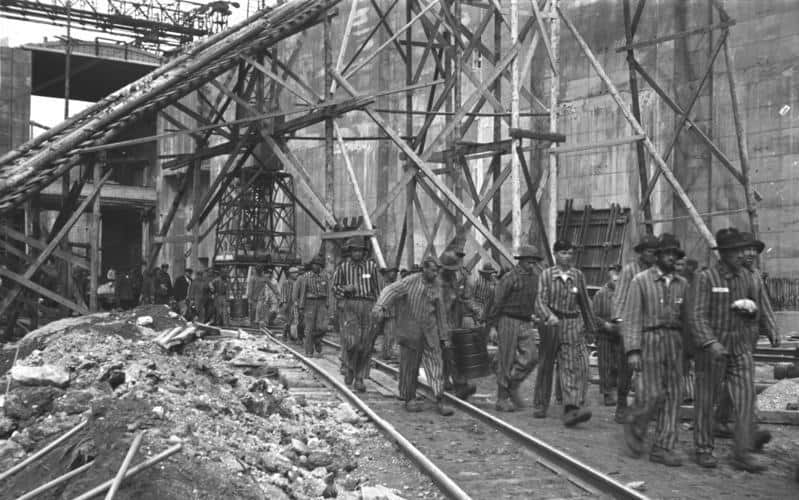
2. The early camps were designed for forced labor rather than mass executions

Near the end of 1938, the mass imprisonment of Jews and other “indesirables” began. For the first time, after the number of arrests of Jews following the annexation of Austria and Kristallnacht, Jews became the majority of persons sent to the camps. At the time the official policy of the German government was the forced deportation of Jews, rather than genocide. Jews sent to the camps (which were at the time all within Germany proper) were sent as forced laborers. They were joined by Roma, Jehovah’s Witnesses (for refusing to be conscripted into the German military), others who avoided conscription, homosexuals, the chronically unemployed, and vagrants.
They were also joined, beginning in 1937, with criminals who had a record of prior convictions. Recidivists were arrested en masse in several raids ordered directly by Himmler. The state prisons were also swept for career criminals, and these too were dispatched to the camps in Germany. There they were forced into certain jobs in which the prisoners saw to the daily operation of the camps, under the direct supervision of SS guards. Known as Kapos, they served as kitchen supervisors, secretaries, barracks supervisors, and in other roles. Because they could be removed from their role for unsatisfactory performance, they were granted certain authority over their fellow prisoners.


