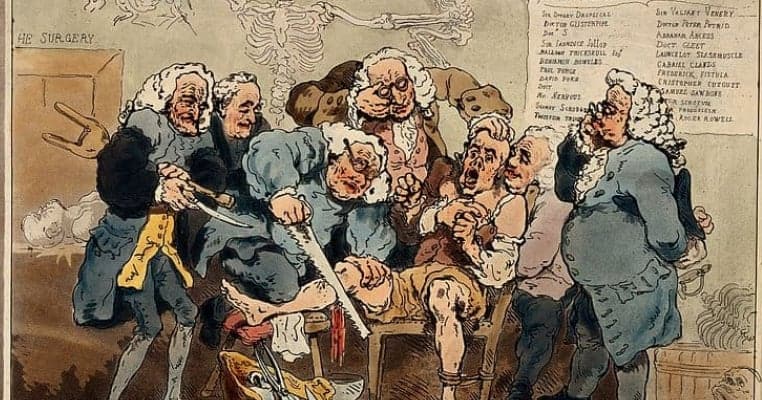

7. Despite their limited knowledge and rudimentary skills, many 19th century surgeons were happy to perform extremely complex – and risky – operations.
Even at the end of the Victorian era, surgical techniques were rudimentary at best. But that didn’t stop the surgeons of the 19th century attempting some mind-bogglingly ambitious and intricate procedures. They didn’t just do amputations all day. Making full use of the latest anatomical research and text books, surgeons operated on the tongue, the ear, face and even the eyes of their desperate patients. For instance, one textbook advised surgeons on how to correct abnormal alignment of the eyes. This required splitting the muscles holding the eyeball in place in two – often without giving the patient anesthetic first.
Other ambitious surgical procedures involved the removal of tumors or cancerous growths. Surgeons would peel back the whole face in order to get access to the jaw or the back of the tongue. In some cases, large parts of the jaw were removed, again without the aid of anesthetic. Some surgeons even attempted brain surgery, though they usually made a patient’s condition worse rather than curing them. The Wellcome Collection in London is home to the world’s finest – and most gruesome – collection of Victorian medical illustrations, showing the wide range of procedures the era’s surgeons tried to perfect.


