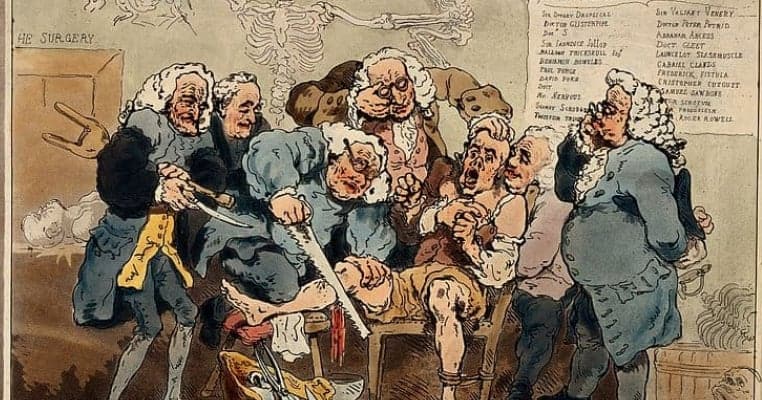

3. It wasn’t just grim for the patients; spare a thought for the poor surgeons of the 19th century who had to endure blood, guts and death on a daily basis.
Surgery wasn’t just traumatic for the patients. It was also highly demanding for the surgeons themselves, in more ways than one. For starters, surgeons needed to be physically fit and strong, mainly so that they could hold their patients down. Robert Liston, famed for his extra-quick amputations, towered above his colleagues, standing six foot two, and he was said to use one his huge arms to clamp a flailing limb down while using his free hand to saw it off. However, having a strong arm wasn’t enough. A surgeon needed to have a strong stomach too. Many trainees simply couldn’t handle it and passed out whilst watching experienced surgeons at work.
Silas Weir Mitchell, was one of America’s most influential physicians and made a name for himself as a pioneer in the field of neurology. As a young man, however, he wanted to become a surgeon – that is, until he witnessed the gruesome reality of an operating theater for himself. In his memoirs, Mitchell recalled a female patient under the knife. In particular, he remembered “the terribleness, the screams, the flying blood jets”. Like many other young men, Mitchell quickly abandoned his careers plans, preferring the relative calm of a physician’s life instead.


