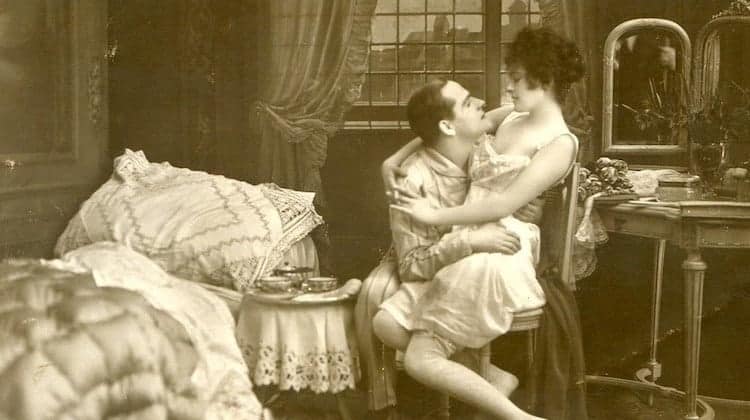
3. The final few decades of the Victorian era saw the emergence of sexology as a serious subject, with new genders and sexualities identified

Far from ignoring matters of intimacy, towards the end of the Victorian era, such subjects were becoming the focus of academic scholarship and serious debate. To some degree, such debates served to reinforce traditional, patriarchal concepts of copulation. For instance, the emergence of Darwinism supported the belief that men had ‘natural’ urges and were far more randy than women. Biologists and anthropologists used the latest scientific breakthroughs to support the idea that men were ‘programmed’ to be promiscuous – and, as such, a good, understanding wife should turn a blind eye to her husband’s liaisons with working girls.
On the other hand, however, this much discussion about reproductive habits was positively progressive. For example, the sexologists – a profession that emerged around the 1880s – Richard von Kraft-Ebing and Havelock Ellis created the terms “heterosexuality” and “homosexuality” as well as “nymphomaniac”. They started analyzing personal intimate preference and started to realize that there was a ‘scale’ rather than simply assuming sexuality to be a binary matter, though they also argued that there were both ‘normal’ and ‘perverse’ tastes and practices. Moreover, Ellis theorized that there was a ‘third sex’ between male and female.


