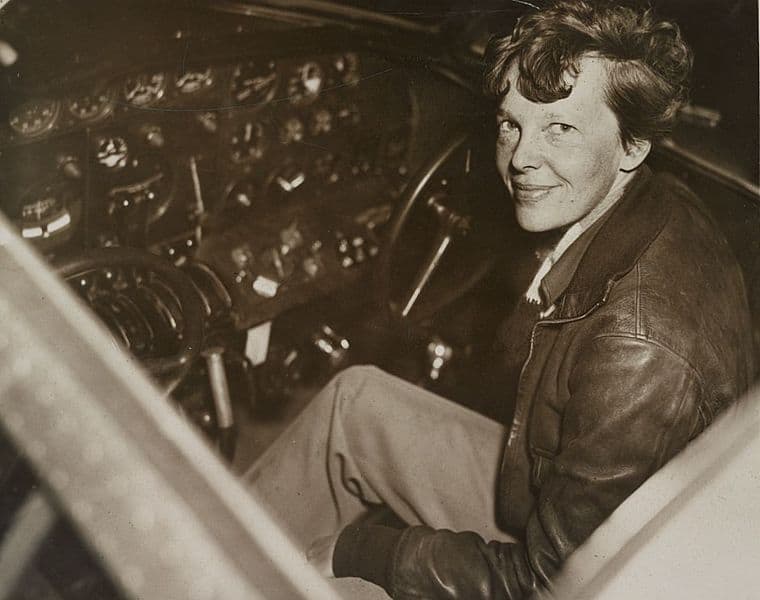
8. Preparations for a circumnavigation flight

By 1936 several teams of flyers completed circumnavigations of the globe, first accomplished by the US Army Air Service in 1924. Earhart planned a flight to eclipse them all in terms of distance, staying on an equatorial route as much as possible. The flight she envisioned covered 29,000 miles, with some legs too long for her tried and true Lockheed Vega to cover. She obtained funding from several sources, primarily Purdue University, and worked with Lockheed engineers and designers on a modified Electra 10E, with the fuselage altered to carry greater loads of fuel. Lockheed assembled the twin-engine aircraft at Burbank, storing the finished plane at the flying school at Burbank Airport.
For press consumption Earhart called the Electra her flying laboratory, implying the flight was to gather scientific and research data for aeronautical research. In reality, Earhart planned a book based on the events of the flight, with no additional scientific requirements or experiments planned for the journey. For her navigator, she approached Captain Harry Manning, whom she had met when returning from Europe following her transatlantic flight. He commanded the ship which brought her home. Manning was a navigator, qualified radio operator, and a pilot. The flight plan included a two-person crew – Earhart and Manning – traveling around the equator in an easterly direction.


