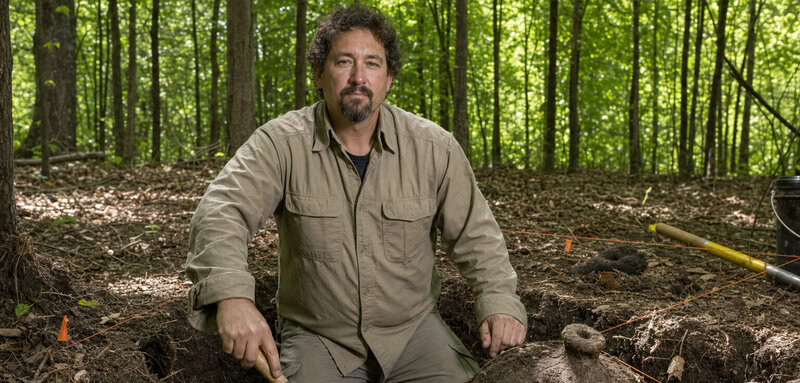
The hollow has a name that stops you: Deadman. It sits inside Morgan-Monroe State Forest in south-central Indiana, a wooded crease where the canopy closes overhead, the leaf litter runs two centuries deep, and the silence has a texture to it — the kind that suggests something was buried here long before the timber companies arrived, long before Indiana was even a word on a map.
A $50,000 Grant, 60 Acres, and a Very Old Question
In November 2026, Indiana Public Media reported that Ball State University would receive a $50,000 federal grant to survey 60 acres of Deadman Hollow inside Morgan-Monroe State Forest. The grant’s stated purpose is to study both pre- and post-contact history at the site — scholarly shorthand for evidence of Indigenous life before European arrival and the disrupted, diminished world that followed.
The pairing of numbers — 60 acres, $50,000 — sounds bureaucratic until you consider what may be waiting inside those acres: material evidence of people who knew this forest intimately centuries before it had a name on any American map, before any American map existed at all.
What Pre-Contact Indiana Actually Looked Like
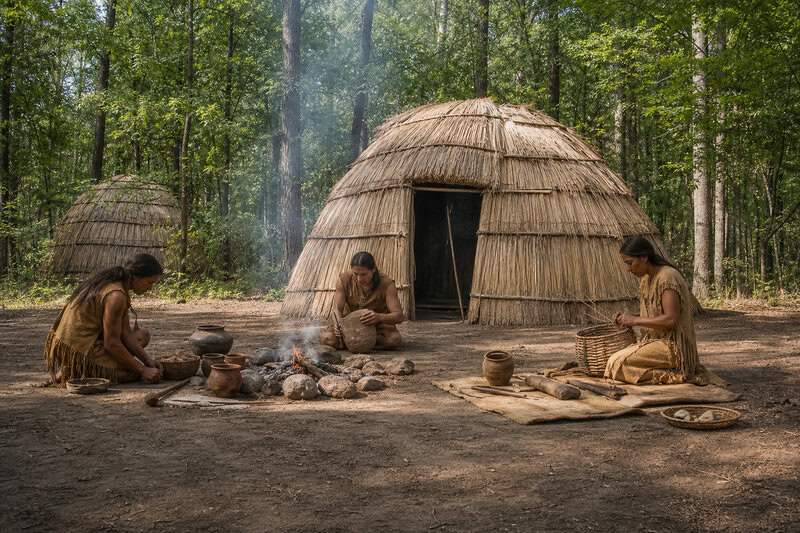
The word “pre-contact” carries a corrective weight worth pausing on. For much of the nineteenth and early twentieth centuries, the standard story of Indiana’s interior cast the land as essentially empty before Euro-American settlement — a wilderness awaiting purpose. The archaeology has always told a different story, and the work at Deadman Hollow is part of a sustained scholarly effort to make that story audible.
Pre-contact Indiana was no empty woodland. The Miami, Lenape, and Shawnee moved through these hills in the centuries immediately preceding European contact, and before them, cultures whose names we have only begun to reconstruct from postholes and pottery sherds — communities that hunted, burned, planted, and shaped the landscape on its own terms. Morgan-Monroe State Forest sits in the knobby hill country of Morgan and Monroe counties, terrain that made for marginal farmland but excellent hunting and gathering territory. The narrow creek valleys, the ridge lines, the places where flint outcrops near water — these were known and mapped in human memory long before any surveyor’s chain was stretched across them.
The region’s topography — too rugged for the deep plow, too hilly for large-scale row-crop agriculture — means it escaped the mechanical destruction that erased so many Indiana archaeological sites on flatter ground. That is the quiet paradox at the heart of this project: land considered marginal by one culture was, inadvertently, preserved as the memory of another.
Why Morgan-Monroe, and Why Now
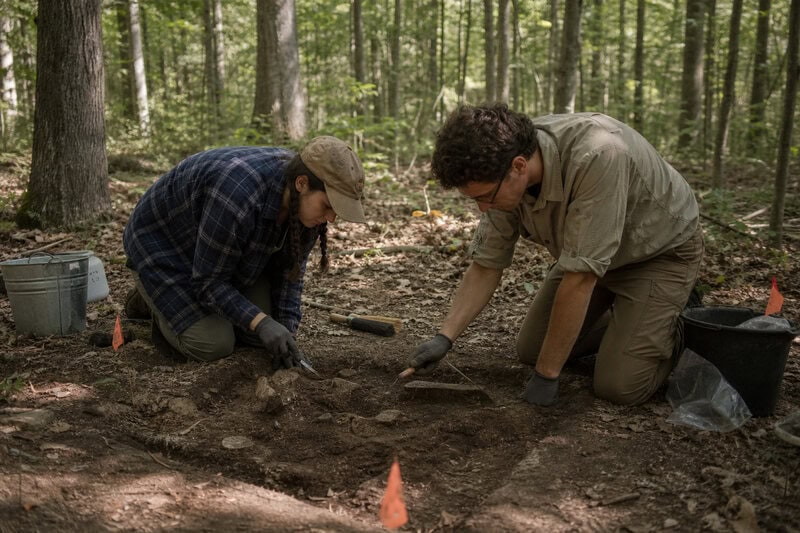
Morgan-Monroe State Forest was assembled by the state in the early twentieth century largely from exhausted, cutover tracts — land the timber industry had stripped and left behind. The reforestation that followed was a genuine conservation success: the forest grew back, the creeks cleared, and thousands of acres were locked away from further development. What was not widely advertised at the time is that locking land away from development is also, quietly, a form of archaeological preservation.
The deep plow — the instrument that destroyed more pre-contact site stratigraphy than any other single force in the Midwest — never ran systematically through these hollows. What the plow missed, the forest held. And what the forest held, a careful survey can recover.
The 60-acre survey zone in Deadman Hollow was almost certainly selected because existing documentary or surface evidence hinted at cultural activity — the kind of preliminary signal that formal pedestrian survey and subsurface testing can either confirm or productively rule out. Archaeology considers a well-documented negative result to be data, not failure. If the survey team walks every transect in Deadman Hollow and finds nothing, they will have told scholars something true and useful about where people were not, or chose not to leave lasting marks.
Timing matters too. Federal funding for this kind of shovel-and-screen fieldwork is competitive and awarded in cycles that don’t wait for researchers to feel ready. The $50,000 grant represents a genuine window, and Ball State moved deliberately to open it.
The Science Inside a $50,000 Budget
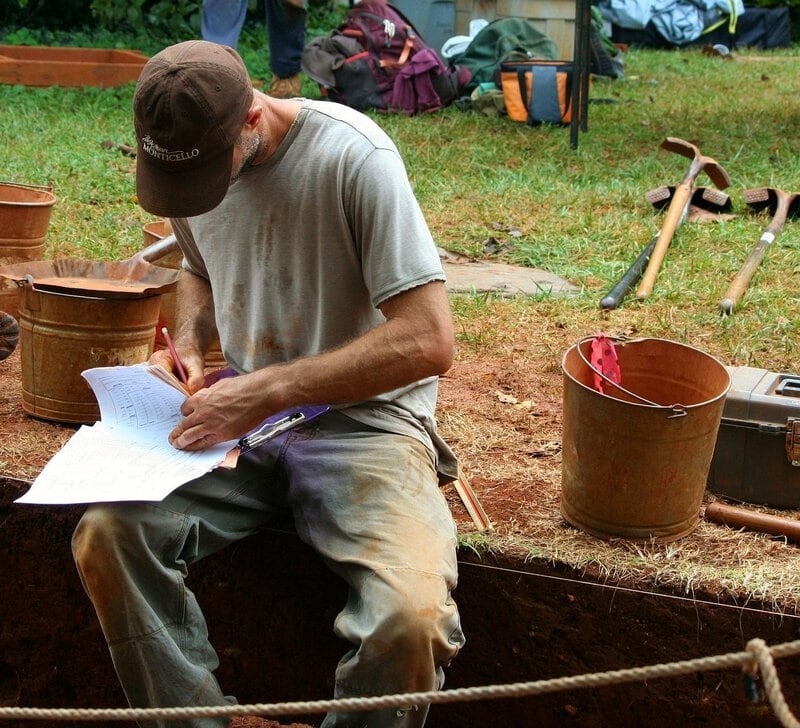
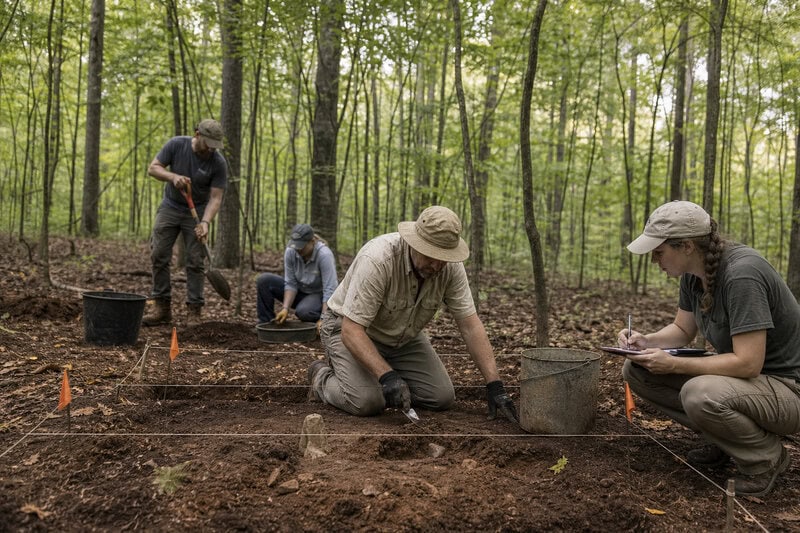
A 60-acre archaeological survey is not a metal-detector weekend in the woods. It typically involves a trained crew walking systematic transects spaced every 15 to 30 meters across the survey area, recording every artifact, every soil anomaly, and every feature on a GPS-linked map built in real time. The work is methodical to the point of meditative, and exhausting in ways that don’t show up on a project budget.
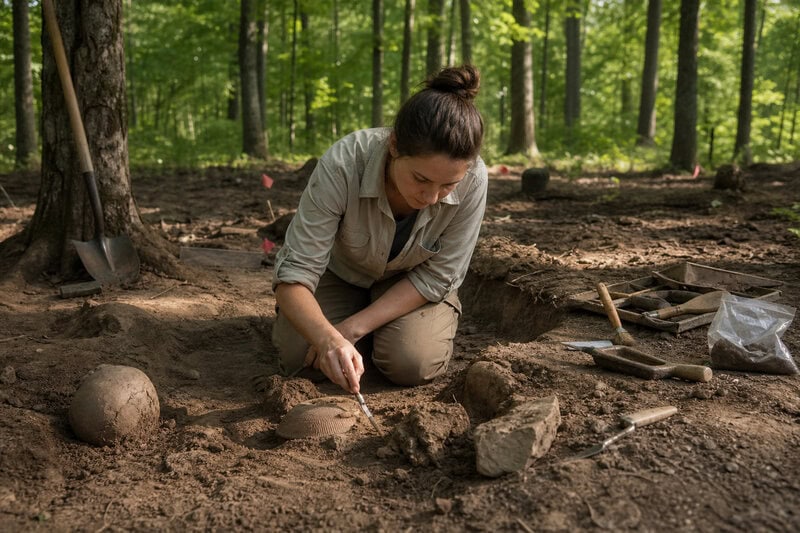
Below the surface, shovel test pits dug at regular intervals and screened through quarter-inch wire mesh can reveal cultural deposits entirely invisible from above — the difference between a featureless forest floor and a midden that changes everything scholars think they know about site use in the region. Soil color, texture, and the presence of charcoal or burned rock can tell a practiced eye how long ago a fire burned at a given spot, whether it was a campfire or a controlled burn, and whether people returned across multiple seasons or used the site once and moved on.
The $50,000 budget covers the unglamorous arithmetic of field archaeology: crew wages, equipment, laboratory processing of recovered materials, and the curation of whatever the ground yields. That last item matters more than it sounds. Artifacts removed from the soil become the permanent record of a site. They must be catalogued, conserved, and stored in a facility that will outlast the grant, the project, and quite possibly the careers of everyone involved. The team will produce a formal site report feeding into Indiana’s Division of Historic Preservation and Archaeology database, meaning the data outlasts the grant by decades — available to researchers not yet in graduate school.
The Longer Story Morgan-Monroe Has Never Fully Told
Indiana state forest history, as officially written, tends to begin with the timber era and the conservation movement of the early twentieth century — a story of depletion and recovery, of bare hills replanted and watersheds restored. It is a genuinely important story. But it has always had a quieter, older story running beneath it, one the official narrative skips over with the ease of long habit.
The Indigenous communities who shaped this landscape through controlled burns, hunting camps, seasonal trails, and intimate knowledge of where the deer sheltered and the nut trees grew are present in Morgan-Monroe’s ecology whether the management plans acknowledge them or not. Their trails became the survey lines of Euro-American settlers. Their clearings became the first fields. Their understanding of the land’s rhythms was the original knowledge on which everything subsequent was built, and then forgotten.
The post-contact layer of the survey may reveal something more complicated still: the archaeology of displacement itself. The seventeenth and eighteenth centuries in Indiana were not quiet. They were centuries of epidemic disease, forced movement, and communities navigating catastrophic disruption while still managing to live, to make things, and to leave traces in the soil that resist any simple story of an empty forest waiting to be discovered. Those traces are part of what 60 acres of Deadman Hollow might hold.
Ball State’s Role, and the Obligations That Come With It
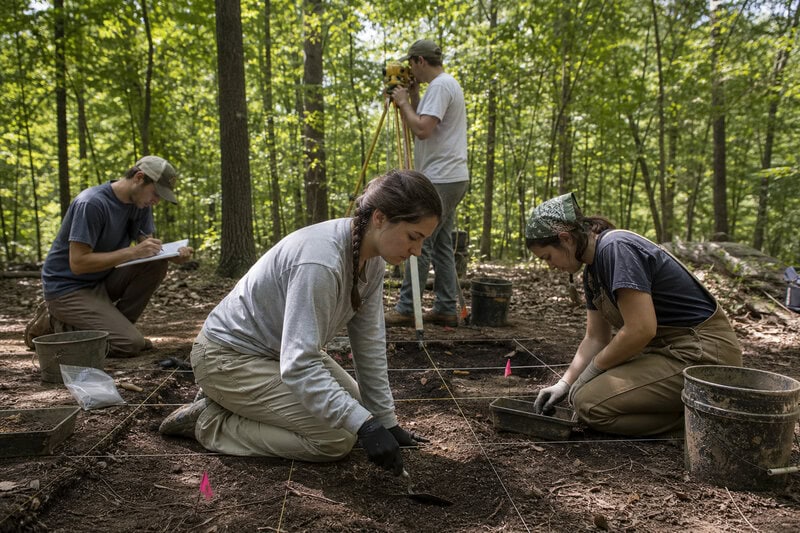
Ball State University’s archaeology program has built a sustained research presence on Indiana’s public lands over the years, training students in field methods while generating knowledge that state agencies rely on for land management and preservation decisions. The Morgan-Monroe survey is simultaneously a research project and a teaching one — the kind of field school experience where students learn that archaeology is fundamentally the practice of asking who was here, and refusing to accept silence as a final answer.
The grant also arrives at a moment when federal investment in Indigenous cultural heritage has become more explicitly tied to consultation and ethical obligation. Section 106 of the National Historic Preservation Act requires that federal undertakings consider their effects on historic properties. The broader scholarly community has moved steadily toward recognizing that descendant tribal nations are not merely stakeholders to be notified — they are partners whose knowledge, authority, and ongoing relationship to these sites must shape how the work is done and what happens to what it finds.
That context means the survey will almost certainly involve formal conversations with descendant communities — an acknowledgment, built into the structure of the project, that the people whose ancestors left these sites are still present, still attentive to what the shovels find, and owed something more than a footnote in a site report. Regional outlets covering Bloomington and south-central Indiana have taken note, a sign that the communities surrounding Morgan-Monroe are paying attention too.
What the Hollow Might Say
When the crew walks the first transect line into Deadman Hollow — clipboard in hand, spread across the hillside, the forest floor giving slightly underfoot — the stakes will be larger than the acreage suggests. Every site formally recorded is a site that can be protected. Every site missed is one that erosion, development, or institutional indifference can erase permanently.
The soil could yield a lithic scatter: the knapped edges of a tool made and discarded here centuries ago. It could reveal a hearth feature, a ceramic assemblage, or a pattern of post molds that rewrites the settlement map of Morgan-Monroe State Forest and adds another chapter to the long, still-unfinished record of Indiana’s Indigenous past. Or it could yield nothing formally significant — and that too would be true, and worth knowing.
Either way, Deadman Hollow will have been listened to. Which is, one suspects, the least a place with that name deserves.