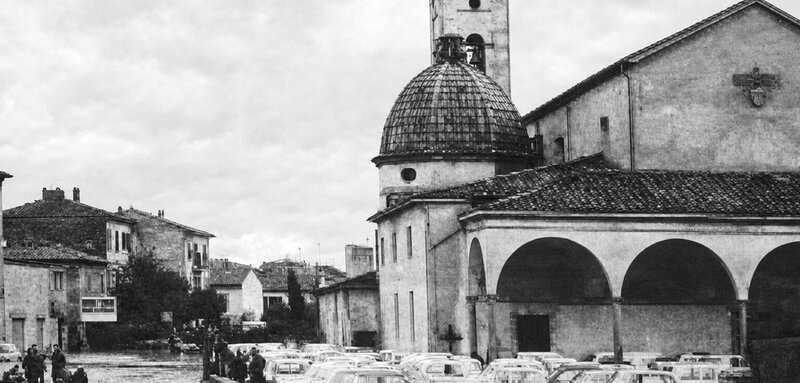
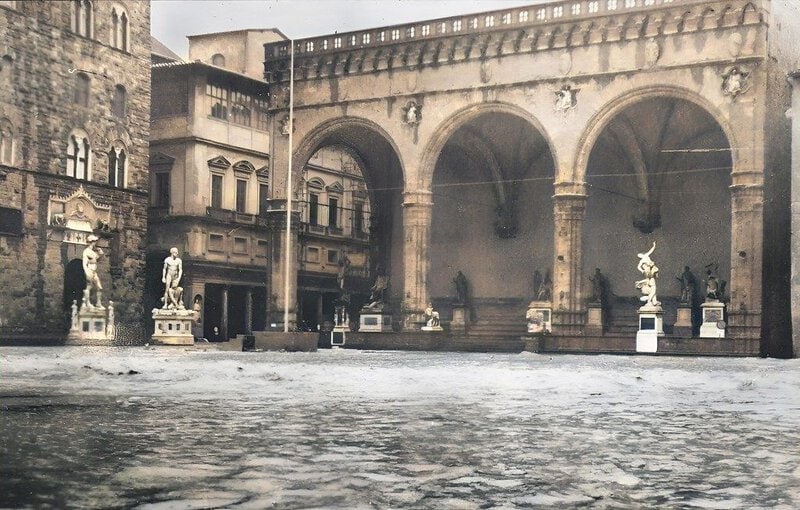
On the morning of 5 November 1966, the Piazza Santissima Annunziata looked less like one of Florence’s most elegant Renaissance squares and more like the floor of the Arno itself — a vast, still sheet of brown water threaded with heating oil, splintered timber, and the accumulated debris of a city that had been swallowed in a single night. Somewhere beneath that surface, inside a Medici palace just across the piazza, three thousand years of Mediterranean civilisation sat in the dark.
The Palace That Held Three Thousand Years
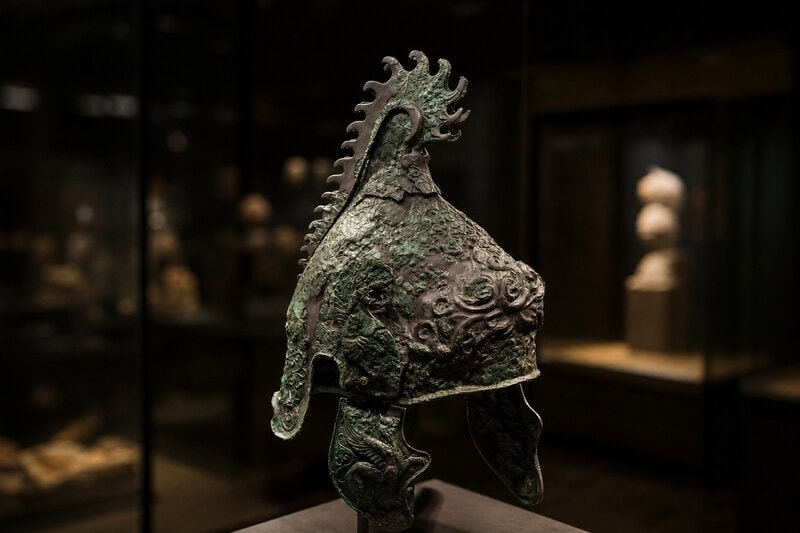
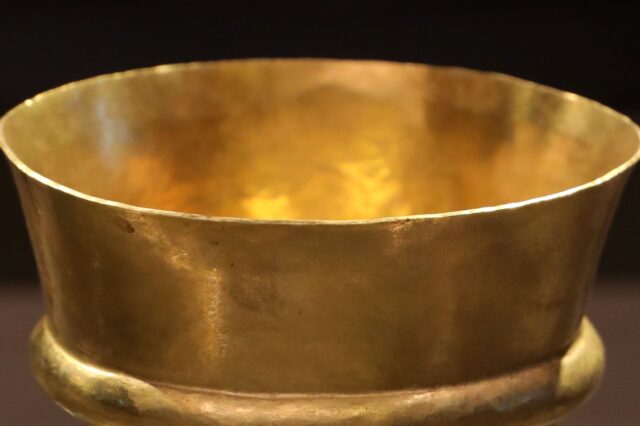
The National Archaeological Museum of Florence occupies an old Medici Palace, a building whose stone walls had already weathered centuries of Florentine politics, dynastic upheaval, and the ordinary violence of time before they were asked to withstand a flood. By November 1966, those walls enclosed one of the most extraordinary compressions of Mediterranean civilisation anywhere in Italy: Etruscan grave goods hauled from the soil of Tuscany, one of Europe’s finest Egyptian collections, Greek and Roman sculpture, and thousands of small finds from excavations across the region. These were not copies or casts. They were the real things — bronze, bone, linen, papyrus — and by the early hours of 5 November, they were underwater.
Directly across the piazza, the Museo degli Innocenti carried its own layered history into the flood. Founded in the fifteenth century as Europe’s first purpose-built orphanage — its famous loggia designed by Brunelleschi, its terracotta roundels by Andrea della Robbia — the building had accumulated five centuries of donated art: paintings, sculpture, and archival records of the charitable life conducted within its walls. The geographical intimacy of the two institutions, separated by nothing more than the width of a Renaissance square, meant the flood struck both simultaneously. It is precisely this shared geography, and the shared catastrophe it produced, that the new joint exhibition makes explicit for the first time.
The Night the Arno Decided
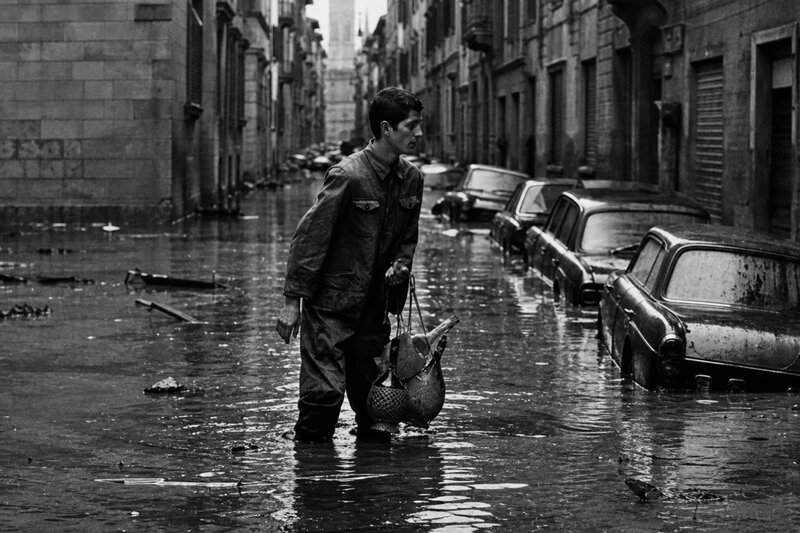
The Arno had been rising for days. By the early hours of 4 November 1966, it had breached its banks at multiple points along Florence’s historic core, and what poured into the low-lying streets was not clean water. The river surge carried with it thousands of litres of heating oil released from flooded basement tanks — a viscous, black-brown tide that clung to every surface it touched, including painted canvas, ancient bronze, and three-thousand-year-old papyrus. Water, eventually, recedes. Oil does not leave so cleanly. It penetrates fibres, corrodes the micro-environment that keeps ancient organic material stable, and bonds with the silt it carries into every crack in every object it reaches. The contamination turned what might have been a recoverable disaster into a conservation catastrophe of the first order.
Museum staff had no warning adequate to the scale or speed of what came. The overnight inundation was fast enough that vast sections of the archaeological collections on the lower floors were submerged before any systematic removal could begin. The objects were left to face the Arno alone.
There is something almost unbearable about that image — Etruscan bronzes, Egyptian mummies, Greek painted vases sitting in total darkness as the oily water rose around them — and it is worth sitting with it for a moment before moving to the morning, when the rescue began.
The Morning After: Conservators in Rubber Boots
The day after the flood, conservators made their way to the National Archaeological Museum. As one account from those who were present records, “the following day we went straight to the National Archaeology Museum, located in an old Medici Palace.” That sentence, plain as a field note, carries the whole weight of what it describes: trained specialists arriving at a building full of mud, with no clear picture of what they would find inside, ready to begin work.
They were not alone in the city. Thousands of rescue volunteers — students, art lovers, and ordinary citizens who had travelled to Florence from across Europe and beyond — were already moving through galleries and churches, passing objects hand to hand through waist-deep silt. History would eventually name them the Mud Angels. But the conservators arriving at the archaeological museum faced a specific, technical challenge that goodwill alone could not solve: they had to understand, before they could act, what the mud had done.
The silt had reorganised storage areas, overturned display cases, and in some instances fused objects together. Cataloguing the damage was itself a form of archaeology, conducted in rubber boots and against the clock. The Etruscan bronzes were among the most urgent concerns. Their patinas — built across two and a half thousand years of burial and careful conservation — could be permanently disrupted by prolonged immersion in oxygenated, oil-laden water. The organic materials were worse still: wooden artefacts, the linen wrappings on Egyptian pieces, papyrus fragments faced the acutest danger, since the alternating wet-dry cycle of a flood’s retreat accelerates exactly the kind of decay that burial had suspended for millennia.
Some objects survived by sheer chance. Upper-floor cases, inner storage rooms, or the simple luck of a closed cabinet door that slowed the mud’s advance long enough for the water level to begin dropping — these accidents of placement saved things that skill and intention had not been able to protect. Across the piazza, the Museo degli Innocenti’s losses included not only artworks but the orphanage’s own archival records: documentary memory of five hundred years of charitable life, irreplaceable in a way that even the finest painting is not quite.
The Exhibitions: Standing Where the Water Stood
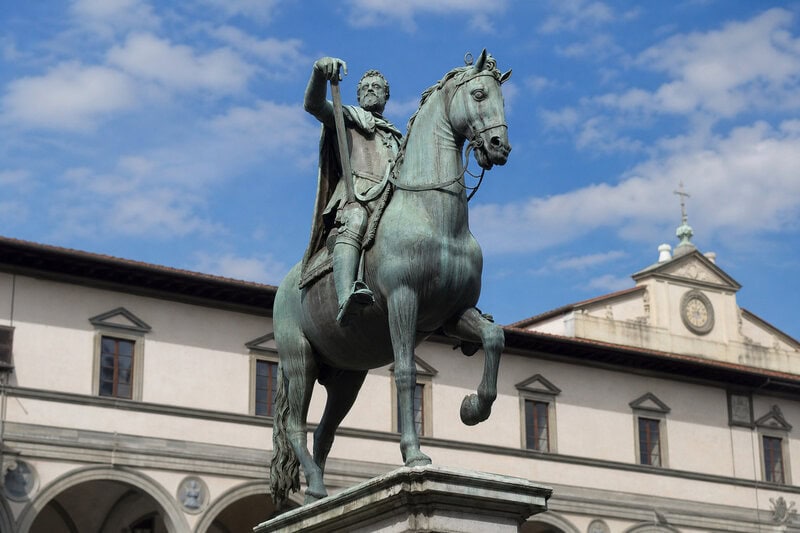
The joint exhibition — The 1966 Flood in Piazza Santissima Annunziata: The Innocenti and the Archaeological Museum amid Water, Mud and Rescue — reconstructs the disaster through the specific geography of a single Florentine piazza, and the curatorial argument is quietly powerful: place, not just event, is what gives the story its meaning. The curators have not taken the flood’s history to a neutral third venue. They have kept it inside the buildings that flooded, which means that visitors standing in the exhibition rooms at the Museo degli Innocenti are standing in rooms where the waterline once rose above head height. The architecture becomes a primary document.
The Museo degli Innocenti show, running from 20 October to 4 April 2027, assembles over 50 works drawn from more than 40 museums — a loans list that is itself a kind of map of the flood’s reach, tracing how widely 1966 scattered Florence’s objects and how many institutions have held pieces of that story in the decades since. For the curious general reader, the shows offer something rarer than a disaster narrative: a close study of what it actually costs, in expertise, time, and material ingenuity, to pull three thousand years of human making back from the edge of permanent loss.
Why 1966 Still Belongs to the Present
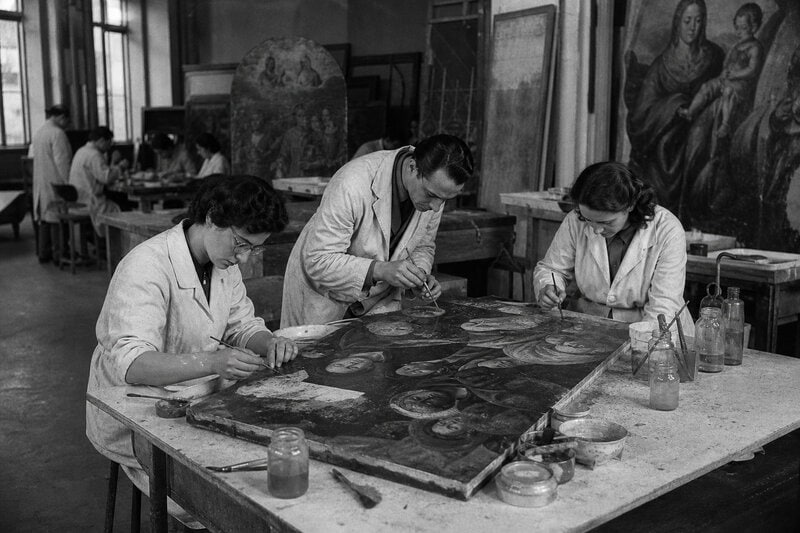
The 1966 Florence flood did not only destroy things. It also, in a painful irony that conservation scientists have noted ever since, created things: specifically, it created the foundations of modern conservation practice. Techniques developed in the mud of the Arno — new approaches to consolidating waterlogged wood, methods for treating oil-contaminated pigments, protocols for stabilising ancient organic materials in emergency conditions — are now standard practice worldwide. Every cultural heritage institution that has faced a flood since 1966 has drawn, knowingly or not, on a Florentine inheritance. The conservators who faced the disaster worked with the tools and knowledge of the mid-twentieth century; those who would face a comparable event today work with methods whose lineage runs directly back to the emergency decisions made in those November weeks.
That lineage matters, because the Arno has not changed its character. Climate projections for the river basin suggest the 1966 event is not a closed historical chapter but a live precedent. Florence’s flood-prone geography is what it is — the city was built in a river valley, and it has been arguing with that fact for centuries. The question of what Italy learned in 1966, and what it has yet to fully protect, gives both exhibitions an urgency that sits some distance beyond ordinary commemoration.
The piazza itself, unchanged in its Renaissance proportions, holds the answer to this article’s opening image. The water is gone. The Brunelleschi loggia still stands, the della Robbia roundels still gaze outward from their spandrels, and inside the museum across the square the artefacts that survived — the Etruscan bronzes, the Egyptian pieces, the Greek painted vases — are still there, still available to be looked at and wondered over. They did not survive by accident. They survived because named people with specific skills arrived the morning after and refused, one muddy object at a time, to let three thousand years disappear.
Both exhibitions are open now. The piazza is dry. Go and stand where the water stood.