4. Few could last long sitting on the Witch’s Billy Goat
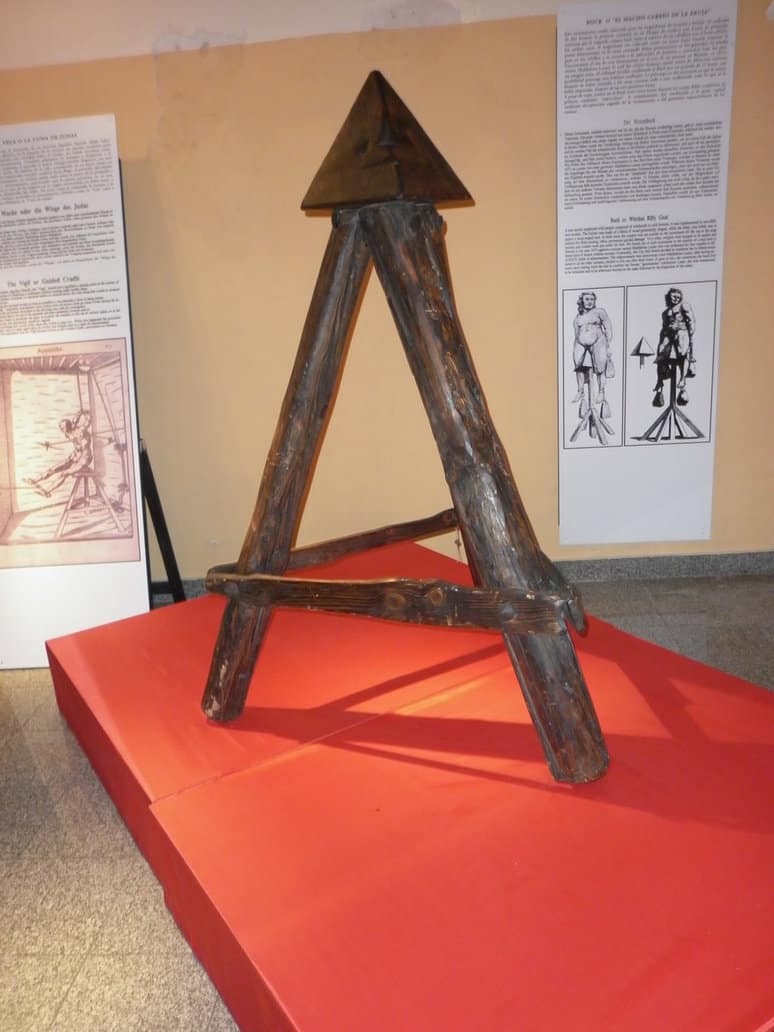
A form of torture that could, potentially, be fatal was the Witch’s Billy Goat, so-called because it was used to extract confessions from suspected witches, who were believed to ride goats instead of horses. Also known as the Judas Cradle, the device was a wide and rough-hewn pyramid of wood on a stake, upon which naked victims were lowered with ropes. The point of the pyramid would enter the victim’s vagina, scrotum, or anus, and if sat upon for long enough could, theoretically, cleave them in two. The resulting agony more or less guaranteed a confession, true or otherwise.
The ropes and the pyramid’s width ensured that cleaving would take a long period of time, sometimes even days on end. The width of the pyramid also ensured that full impalement (more on which later) would be impossible, with the focus chiefly on gradually splitting the victim in half. Weights were sometimes tied to the victim’s feet if they were too light to suffer from the Billy Goat. Credited with the dubious honor of having invented the Witch’s Billy Goat is the Spanish Inquisition, but the word of the device’s efficacy saw it spread across Europe from the sixteenth century onwards.


