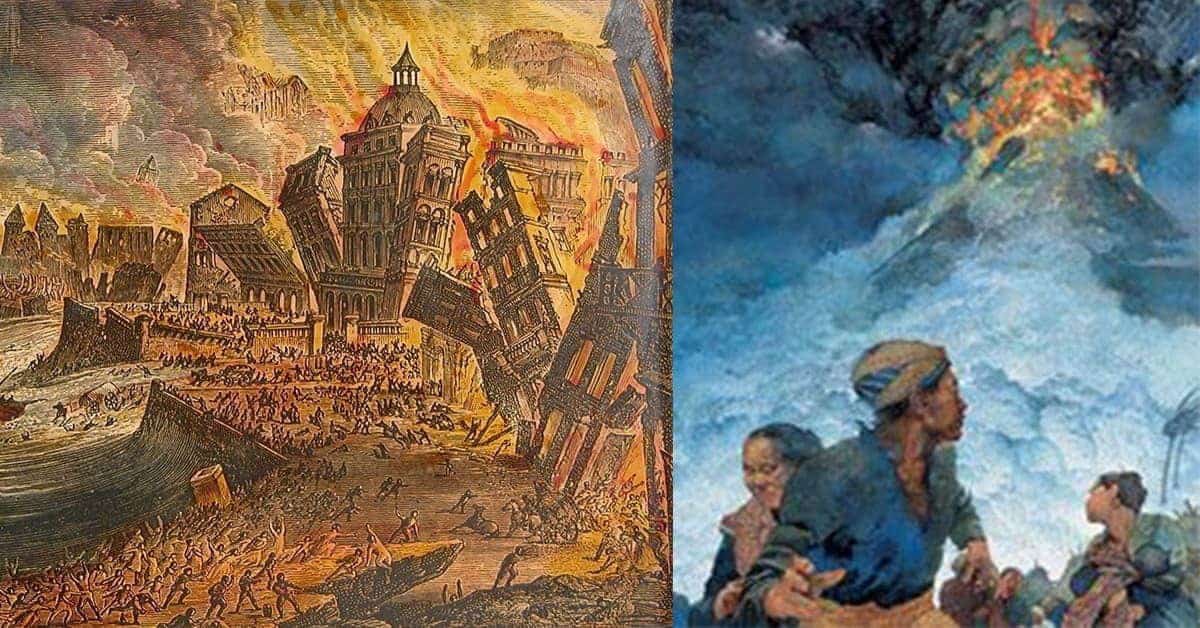

1755 Lisbon Earthquake
On the morning of November 1, 1755, just as it began celebrating the religious festival of All Saints’ Day, the Portuguese capital of Lisbon – at the time one of Europe’s wealthiest cities and busiest seaports – was almost completely demolished by a powerful earthquake of a magnitude 9.0, whose shocks were felt as far away as Finland, North Africa, and even the Caribbean.
Striking around 9:40 AM, the upheaval caused fissures nearly 20 feet deep to open in the city’s streets, and because of the religious festival, a significant percentage of the population were gathered in churches and cathedrals when the tremors began, and thousands were crushed to death as the houses of worship collapsed atop them. As the tremors subsided, another danger arose as fires erupted around the city, first individually then joining together until most of Lisbon was a giant inferno.
Shaken and frightened survivors, seeking to escape the conflagration and collapsing buildings, rushed towards the harbor, where the large open squares of the royal palace promised safety from both flames and falling debris. There, they were further alarmed when they encountered the incongruous sight of a harbor without water, with ships resting on a dried seabed.
Gathering in the drying silt of the harbor’s bottom, they were led by priests in fervent prayers beseeching God’s mercy and forgiveness of whatever sins had occasioned such divine wrath. Many were still praying and begging God’s mercy in the harbor when the sea returned with a vengeance in the form of a tsunami, with a wall of water 40 feet high, and drowned them.
Total casualties are estimated to have been as high as 60,000 deaths in Lisbon alone, with a total of perhaps 100,000 deaths or more in the Lisbon region, plus many more injured. The earthquake occurred as the Enlightenment was getting into full swing, and inspired significant philosophical discourse and exchanges that furthered the development of theodicy, or the question of how a just and good God could allow what happened in Lisbon to take place.
The thorniest theodicy question was why God had sent an earthquake to crush His worshippers by the thousands in cathedrals and churches as they gathered in prayer to celebrate All Saints Day and glorify His name. The question was compounded and made thornier yet by His subsequent sending of a tsunami to drown the survivors who had been praying for His mercy in Lisbon’s harbor.


