
8 – St George’s Fields, 1768
From the Civil War onwards, there was a growing force in British politics: the working classes. Previously, decisions had been made by kings and latterly by the wealthy men of Parliament, but there was a growing trend towards industrialisation and with industrialisation came an increasingly powerful, centralised and influential urban poor that had to be satisfied as well. Furthermore, the principles of Protestantism that had been espoused by the Puritans and the dissident Protestants – free thought, criticism, self-reliance – had lead to more and more people learning how to read, which in turn lead to a plethora of other radical ideas taking hold in the cities.
Among the key demands of those living in the cities, particularly in London, was freedom of assembly and freedom of speech. The conditions that produced the American Revolution and the French Revolution were present in Britain, too, and the skepticism towards inherited rule and monarchy that would characterise those two uprisings was also there. One such firebrand was John Wilkes, a radical journalist and politician who first came to prominence in 1762 as the editor of a newspaper, The North Briton. His paper was regularly critical of the King, George III – for which he was arrested and charged with libel.
Wilkes’ popularity soared after his arrest, with public opinion holding that he had been right to challenge the King and he was soon released when a judge decided that his comments were made using parliamentary privilege – Wilkes was a Member of Parliament – and therefore could not be considered libellous. He was released and sued the men who arrested him. The success embolden Wilkes, who continued to skirt legality with his publications, eventually being forced to flee to France in 1764 to avoid an obscenity charge.
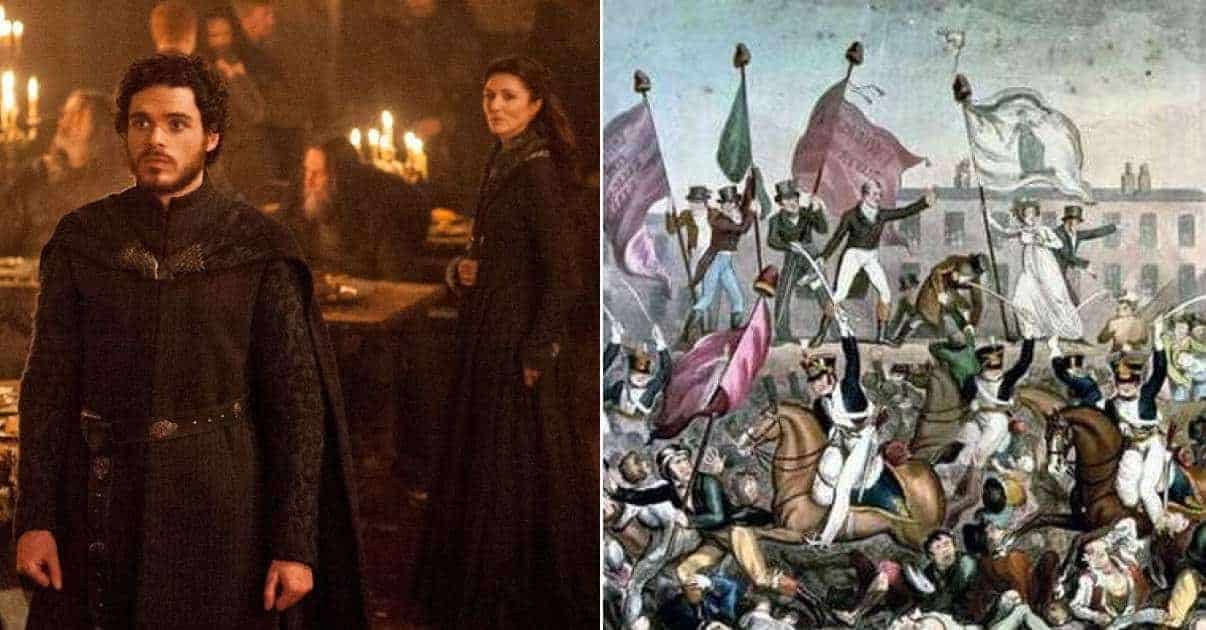
While in exile, Wilkes ran up huge debts and did little to endear himself to people there or back home. When he eventually was forced to return to England, the authorities wanted to arrest him, but instead dithered due to his large public support. He was elected back to Parliament on an anti-government platform and handed himself in, as an MP, to fight the obscenity charge from four years previously. On hearing that he had been arrested again, a crowd began to form on St George’s Fields in south London to call for his release. After two weeks, they numbered 15,000 and were chanting slogans like “No Liberty, No King” and “Damn the King! Damn the Government! Damn the Justices!” outside the gates of the prison. The army were called in and the Riot Act was read – the government’s official signal that a crowd was to disperse. They did not, and began throwing rocks at the soldiers. The soldiers returned fire and soon afterwards, up to 11 people lay dead.
All London erupted into riots against the King and the government, a scene described by Benjamin Franklin, who was present, as “sawyers destroying saw-mills; sailors unrigging all the outward bound ships…Watermen destroying private boats and threatening bridges.” Franklin later saw the riots as a precursor to the Boston Massacre of 1770, which would become a major trigger in the American Revolution.
John Wilkes was eventually released and, six years later, was elected Lord Mayor of London. The rising of the industrial working class against the government in defence of their inalienable rights would become a theme of British city life, and the heavy-handed manner in which it was often suppressed would accompany it every step of the way.


