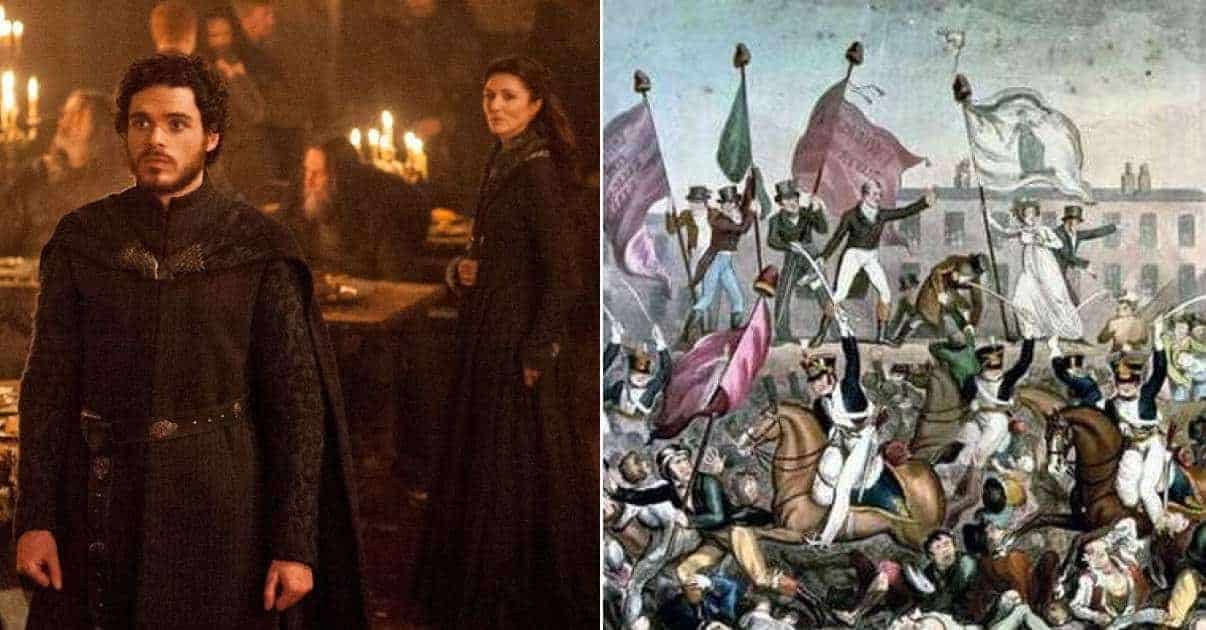

9 – The Peterloo Massacre, 1819
The massacre at St George’s Fields showed the power of the poor of London to cause disruption, but they were far from the only group in England that were capable of rising against the authorities. The north of England was a hotbed of political radicalism and Manchester in particular was the centre of a movement that would have a monumental effect on British society. Manchester in 1819 was well on the way to becoming the first city of industry, the home to the lucrative cotton trade and one of the richest places on earth. The political representation of the city, however, was well out of date and the whole population, which numbered close to a million, was represented by just two Members of Parliament. The economic situation was not much better: the Napoleonic Wars had created a huge demand for textiles with which to make uniforms and created an boom in the Manchester cotton industry, but once the wars ended, the bubble burst and thousands were thrown out of work. The Corn Laws, which regulated the price of grain, kept the cost of food above what most could afford. Thus, the conditions were ripe for protest. The Manchester magistrates warned of “deep distress of the manufacturing classes” and predicted that a revolt was night.
In the years leading up to Peterloo, as it would come to be known, the radical politicians of the north had been doing a roaring trade. They met for weekly meetings throughout the city and were drawing crowds in the thousands. Henry Hunt was the undoubted star of the show, railing against the corrupt Corn Laws and the politicians who upheld them. When he called a “great assembly” on St Peter’s Fields in the centre of Manchester for August 16th, 1819, thousands converged from all over Lancashire to hear him speak. The authorities reacted in kind, with over a thousands soldiers sent to police the event.
Samuel Bamford, who was there, described the scene as thus:
“Mr Hunt, stepping towards the front of the stage, took off his white hat, and addressed the people.
We had got to nearly the outside of the crowd, when a noise and strange murmur arose towards the church. Some persons said it was the Blackburn people coming, and I stood on tiptoe and looked in the direction whence the noise proceeded, and saw a party of cavalry in blue and white uniform come trotting, sword in hand, round the corner of a garden wall, and to the front of a row of new houses, where they reined up in a line.
“The soldiers are here,” I said; “we must go back and see what this means.” “Oh,” someone made reply, “they are only come to be ready if there should be any disturbance in the meeting.” “Well, let us go back,” I said, and we forced our way towards the colours.
On the cavalry drawing up they were received with a shout of goodwill, as I understood it. They shouted again, waving their sabres over their heads; and then, slackening rein, and striking spur into their steeds, they dashed forward and began cutting the people…”
“Stand fast,” I said, “they are riding upon us; stand fast”.
The cavalry were in confusion: they evidently could not, with all the weight of man and horse, penetrate that compact mass of human beings and their sabres were plied to hew a way through naked held-up hands and defenceless heads; and then chopped limbs and wound-gaping skulls were seen; and groans and cries were mingled with the din of that horrid confusion.”
15 people lay dead and hundreds were injured. One of the dead, John Lees, who had travelled in from the nearby cotton town of Oldham and had previously fought at the Battle of Waterloo, remarked: “At Waterloo there was man to man but there it was downright murder.” The name Peterloo was immediately given to the massacre at St Peter’s Fields. Peterloo has gone down in history as one of the worst excesses of the British state against its own people, and the formation of the organised British working class movement. The poet, Percy Bysshe Shelley, was moved to pen his famous lines by the carnage of Peterloo:
“Rise like lions after slumber
In unvanquishable number
Shake your chains to earth like dew
We are many, they are few”


