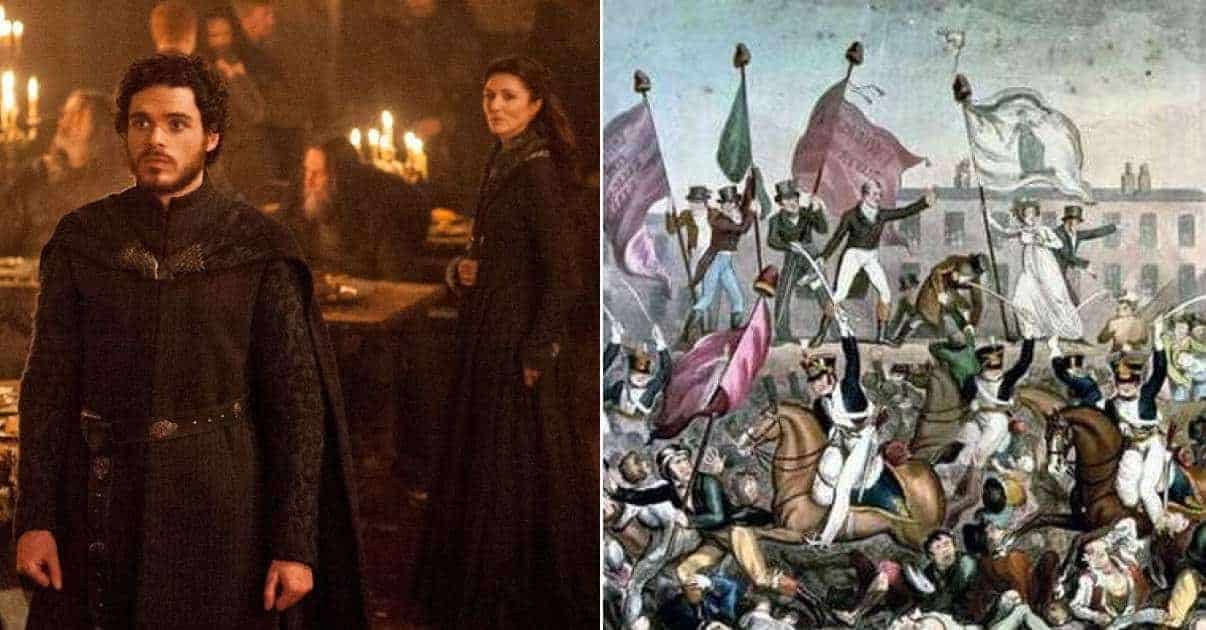

11 – Preston Strike, 1842
The great cleft in British society was now clear to see. As the industrial advances in the cities drew in migrants from the countryside and created a huge, concentrated underclass, the rich grew richer on the profits. A society that had been largely rural – estimates are that 80% of the population lived off the land before Industrial Revolution – had become the first in history to be made up of predominantly city-dwellers. This caused huge, unheard of problems that the ruling classes struggle to deal with. How could they organise food and sanitation for such a concentration of people? How did they maintain order when faced with numbers like they had never seen before?
In the North, the conditions were particularly harsh and particularly stark. The city of Manchester had doubled every ten years for five decades running and the most of those newcomers had been rural, illiterate and unskilled. The damp climate that had made the city so perfect for cotton weaving – Manchester was (and is) so rainy that cotton never dried out and therefore was less of a fire risk – was also perfect for spreading diseases, which caused periodic epidemics among the population. Yet, despite the hardships of the city, the merchants and mill owners made untold riches from the profits of the labour. The French writer Alexis de Tocqueville wrote of Manchester in 1835:
“From this foul drain the greatest stream of human industry flows out to fertilize the whole world. From this filthy sewer pure gold flows. Here humanity attains its most complete development and its most brutish, here civilization works its miracles and civilized man is turned almost into a savage.”
Understandably, the workers were not too keen on their hard work fattening the already rich, while they remained in poverty. The average working class person had no vote, little economic or social mobility and a short life expectancy. They organised the so-called “People’s Charter”, a list of demands handed to the government, in 1838, asking for universal suffrage and political reform. It was rejected out of hand. The workers regrouped and created a second charter in 1842, this one signed by three million people, which was again rejected by Parliament. The Northern Star, a radical newspaper, published this withering commentary on Parliament’s decision:
“Three and half millions have quietly, orderly, soberly, peaceably but firmly asked of their rulers to do justice; and their rulers have turned a deaf ear to that protest. Three and a half millions of people have asked permission to detail their wrongs, and enforce their claims for RIGHT, and the ‘House’ has resolved they should not be heard! Three and a half millions of the slave-class have holden out the olive branch of peace to the enfranchised and privileged classes and sought for a firm and compact union, on the principle of EQUALITY BEFORE THE LAW; and the enfranchised and privileged have refused to enter into a treaty! The same class is to be a slave class still. The mark and brand of inferiority is not to be removed. The assumption of inferiority is still to be maintained. The people are not to be free.”
Many had tired of asking nicely. A huge wave of strikes broke out all over industrial areas, combining the goals of the Chartists with economic demands such as wage rises, a ten hour working day and lower rents. On Friday, August 12, 1842, three thousand people met in the northern city of Preston and began to go from factory to factory, pulling the workers out to join their protest. By Saturday, almost the whole town had ground to a halt and the major mill owner – who was also the town mayor – Samuel Horrocks called in the 72nd Highlanders, an army regiment stationed in the town.
Horrocks addressed the crowd and read the Riot Act, proclaiming the demonstration illegal. When the crowd did not disperse, the soldiers opened fire and shot 8 protestors. The mayor was thought to have given the order to fire, with the Northern Star writing:
“People could scarcely believe their senses. Riots had happened before in Preston but never before had the military been ordered to fire. Another attachment of the 7th Rifle Brigade, about 150 in number were marched into town, and the 72nd were marched out, no doubt to stem popular fury, it being the almost unanimous opinion that the Mayor ought to be tried for wilful murder.”
Of course, nobody was ever found guilty of the shootings and, indeed, many demonstrators found themselves imprisoned for their actions.


