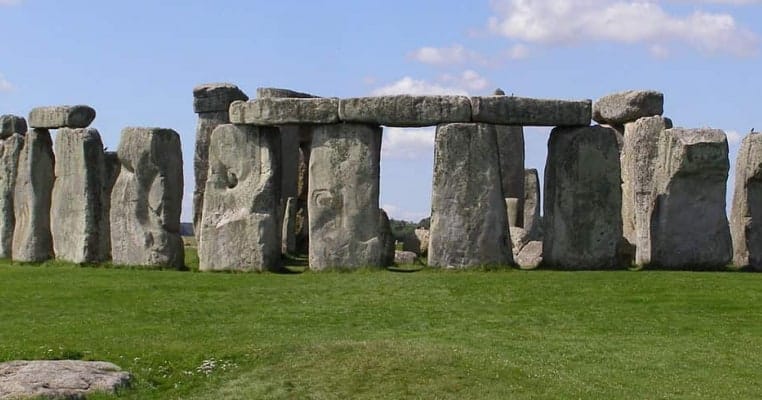
7. It probably took 30 million hours of labor to build Stonehenge

When you’re marvelling at Stonehenge, you not only have to think about how hard it was to move the stones all that way, but how they were positioned with such a perfect alignment to the sun at specific times of the year, and furthermore how they were erected at all. Salisbury Plain is not perfectly flat, and to get the stones to stand perfectly upright required a mixture of brute force and patience. They had to be placed vertically in angled pits dug with flint and antler tools and angled upright with ropes whilst the pit was gradually filled in.
The 9-tonne lintels on top of the standing Sarsens were either rolled up a high bank of sloped earth or moved with ropes and a platform. Their perfect fit would have required much more trial and error, given the slight slope of the ground around Stonehenge. The builders carved mortices to fix the lintels into a perfect horizontal position, which would have required several attempts for perfection. And imagine how many times the stones were erected ever so slightly out of perfect alignment with the sun. No wonder it’s been calculated that it took 30 million man-hours to build.


