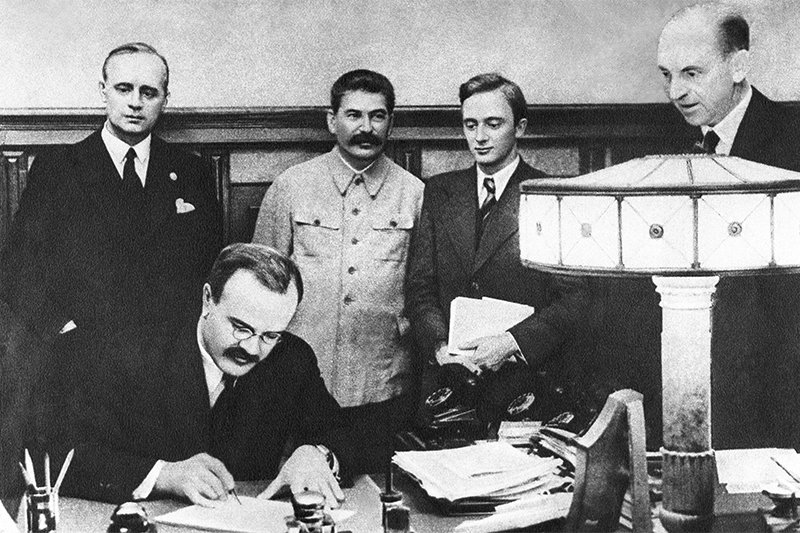
18. Just How Awful Was the Molotov-Ribbentrop Pact?
On August 23rd, 1939, one week before the invasion of Poland that kicked off World War II, Nazi Germany and the Communist Soviet Union stunned the world by signing a German-Soviet Nonaggression Treaty, better known as the Molotov-Ribbentrop Pact. Ever since a widely accepted narrative has developed to the effect that the pact was an awful deal that proved to be disastrous for the USSR. When examined dispassionately, however, in the context of the time and from the perspective of the signatories, especially the Soviets, it made sense.
The Molotov-Ribbentrop Pact was bad for the Western Allies, and was certainly awful for Poland, but it was a good deal for the USSR. Soviet dictator Joseph Stalin subsequently proved disastrously wrong in his faith that Hitler would honor the agreement, and in his stubborn refusal to heed warnings of an impending German attack in 1941. However, the fault in that lay with Stalin, not with the Pact. The Pact itself actually served the interests of the USSR, and while the Soviets did not make the best use of it, they were nonetheless better off for having signed it.


