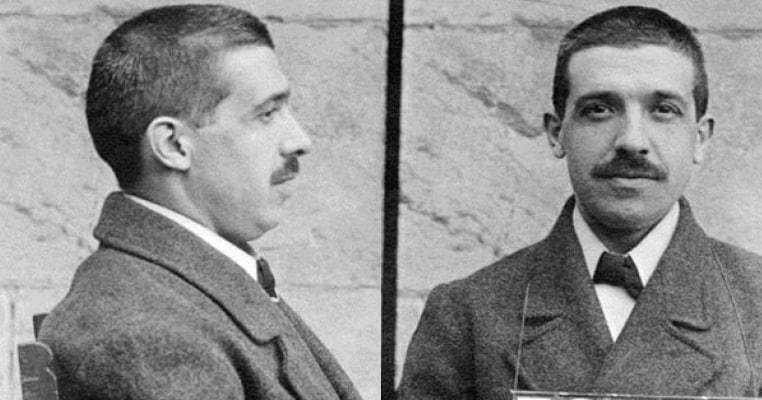

Victor Lustig and Al Capone
Victor Lustig was born in the Austro-Hungarian Empire in a region which is the present day the Czech Republic. He first drew the attention of the authorities as did many other con artists of his day, by plying his trade on the transatlantic steamships which allowed for a level of confidence to be built up between con and mark, within the trappings of wealth and luxury. Lustig was well aware that greed was a trait among many of the wealthy, and to capitalize on it he relied on a scheme known as a money box. Lustig presented his mark with a box which would replicate $100 bills.
After explaining the workings of the box Lustig would print a $100 bill with it, allowing the mark to examine the bill as he lamented that the one problem he still had with the box was its slow speed. According to Lustig, the box would continue to print bills as long as it was turned on but it took about six hours per bill. Lustig would appear to be about to give up on improving the box and the mark, realizing that the box could print $400 per day if left on, would offer to buy it. Lustig frequently sold the box for five-figure sums, always on the evening before the ship was to enter port, or on that morning.
The box would go on to print one or two additional hundred dollar bills, after which the “printing” would cease because those were all the bills with which Lustig had primed the box. By then he was off the ship and lost in the crowds of the port. Lustig pulled off bigger scams in Europe, including the sale of the Eiffel Tower to a group of investors who wanted to sell it for scrap. Lustig presented himself to these investors as a corrupt government official who could ensure that they won the bid to scrap the tower in exchange for a bribe. Thus Lustig received the money for the illicit sale and a hefty bribe in the same scam.
Lustig next went to America, where he made money during the Great Depression in a variety of smaller schemes, trying to keep a low profile as the French authorities were looking for him. In Chicago, Lustig hit upon the idea of defrauding Al Capone. He concocted a scheme in which he convinced Capone to purchase $50,000 worth of stock, in a deal in which both Capone and Lustig would make a significant profit. Lustig simply held on to Capone’s money for several weeks, before approaching the gangster and informing him that the deal had collapsed. He then returned the entire $50,000 which he had held from the gangster.
When Lustig informed Capone that although the gangster hadn’t lost money he had, Capone offered the con artist $5,000 to cover his losses in time and expenses. Lustig’s feigned gratitude ensured that he had an ally in Chicago even as he walked off with Capone’s money in his pocket. A few years later Lustig was caught with counterfeit money and the plates which produced it and he was sentenced to 20 years, serving most of his time in prison in Alcatraz. At one time both he and Capone were inmates there. He died in 1947 of pneumonia, still a federal prisoner.