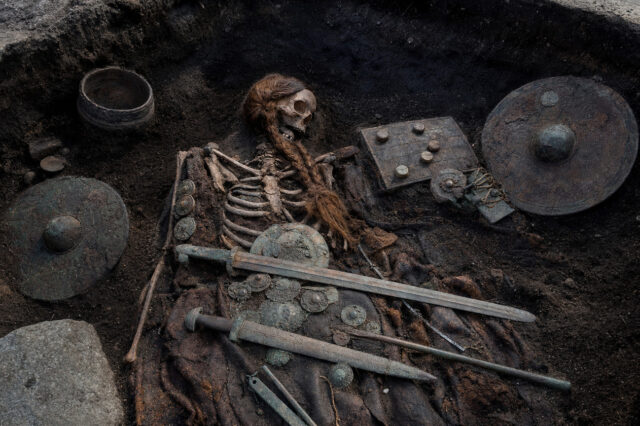
20. The Medieval Knights’ Sword
The sword most often used by medieval knights, aptly named the knightly sword, was double-edged and straight, with a blade that usually measured between 28 to 32 inches. Some had blades of up to 39 inches. Whatever its length, it featured a single-handed cruciform hilt that gave it a distinct cross shape. It was prevalent as the main European sword from the eleventh to the fourteenth centuries. Then it was edged out by the longsword, and was relegated to the role of a secondary weapon or sidearm.

The relegation to sidearm earned the knightly sword another name, the “arming sword”. It traced its roots to an earlier Viking sword, which in turn traced back to an even earlier sword, the Roman spatha. Those earlier swords lacked a key distinguishing feature of the knightly sword: the cross guard that made the latter resemble a cross. The transition from the Viking sword to the knightly sword went through an intermediate phase of the Norman sword in the ninth and tenth centuries.