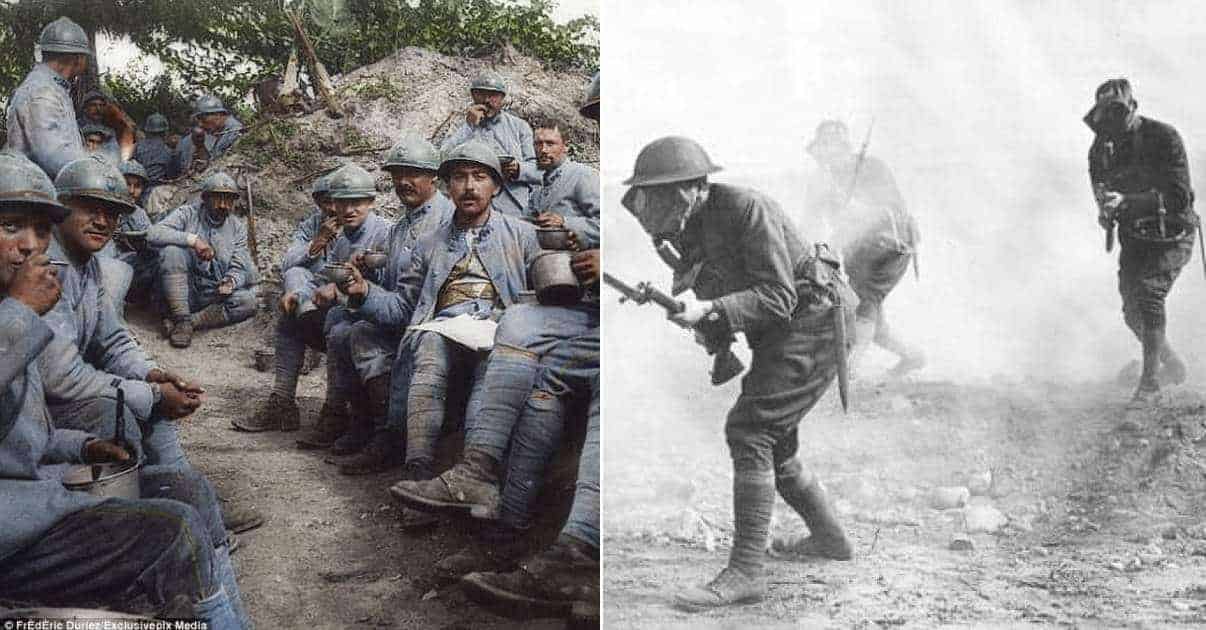

French soldiers accounts of anticipating an offensive assault
An article from a trench newspaper, ‘L’Argonnaute’ from May 1916 provides a uniquely detailed account from a soldier anticipating an offensive assault at the Battle of Verdun. The article describes how the soldiers had braced themselves twice already that morning for an attack, only for it to be postponed both times. The new order stated that the attack was to take place at 14:00 hours. The author of the article describes how a corporal whispers in his ear, asking him, “Is it true this time?” He notes that this corporal is smiling, presumably not thinking of the dangers ahead.
The author himself is much more nervous of the impending danger, he attempts to calm himself by looking at the surrounding landscape. He checks his watch and sees that they are only “five minutes away from the leap into the unknown.” He tries to distract himself from the thought that “he might not be in a position to philosophise in an hour.” He describes the fifteen men of the assault group around him, some of them smoking, others talking quietly, and one who amazingly to the author looks at himself in a small mirror. He describes the “animal nervousness” of two or three of the men, but is confident that all will “rediscover their coolness,” and that “they, like the others, will have got used to the notion of sacrifice.”
When the order is given at 14:00 hours to advance, the author remarks that it is funny that it at this point that he regains his composure, his mind is clear and his body relaxed. In the calm before the storm, he can hear someone humming out on the level ground. His last glimpse is of a field of poppies, “their scarlet petals rippling in front of him like a flame.”
He describes the expressions on the faces of his comrades as they step out onto the battlefield, one named Lapernelle, who he notes is smiling sarcastically as usual, while others follow, frowning with clenched jaws. He describes how in the surrealistic atmosphere of the attack, “seven or eight yellow box shapes” fall beside them, it is only after they explode that he realises that they were artillery shells. The exploding shells leave twelve of the fifteen men wounded, forcing them to retreat back to their original position. When it is all over the author remarks that there “seems to see blood everywhere” and that he feels “a mixture of anger and grief.”
Guy Hallé wrote in Là bas avec ceux qui souffrent (Out there with those who suffer) of his own memories before an attack: “To say to yourself: at this moment I am myself. I am entirely me. My blood circulates and pulses through my arteries. My eyes are where they should be and all my skin is intact. I do not bleed. If they stopped this horrible war right now, right away, I would be able to stretch out and sleep in the sun. Oh, to sleep knowing that it is over, that I will live, that I will have joys and pains, sorrows and pleasures. That I will not be killed.”


