
Gas attacks
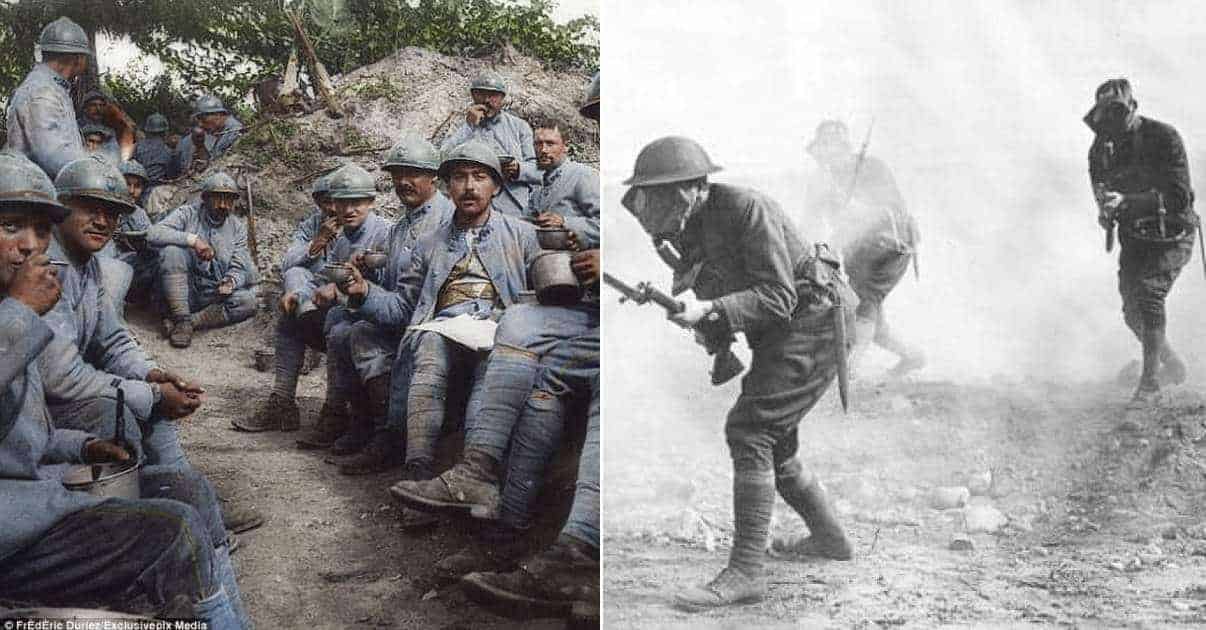
The third principal dread felt by French soldiers was the fear of German gas attacks, especially when gas masks were either unavailable or known to be ineffective. Despite the use of poison gas being outlawed by The Hague Conventions of 1899 and 1907, from 1915 on, gas attacks became another terrifying aspect of trench warfare. As the war progressed the firing of gas artillery shells replaced the earlier less reliable method of simply opening a gas canister into a prevailing wind. Phosgene gas, the main gas used at the Battle of Verdun in 1916, caused much less coughing than did chlorine gas when it entered a soldier’s lungs. As a result, more of it was inhaled. Another feature of Phosgene gas was that it often had a delayed effect; apparently, healthy soldiers died from phosgene gas poisoning up to 48 hours after inhalation.
Simply trying to breathe while wearing a gas mask proved difficult. It also prevented comrades from recognising one another. According to historian Leonard Smith, this combination of physical danger and total anonymity and alienation represented the “nadir of battlefield experience.” In ‘Nous Autres à Vauquois’ (We at Vauquois), André Pézard wrote of the physical torture of wearing the mask during a gas attack:
“You do not see clearly with the glasses, which make you sweat around the eyelids. You have the mechanism, which dances on your nipples. The air heats up in the box of potassium. That scorches you from the bottom of your lungs to your kidneys. The brain begins to turn. The rubber cannula makes you want to throw up, and the saliva runs out of the corners of your mouth.”
Pézard further described witnessing soldiers overwhelmed by the experience:
“There are guys who go crazy, who take out the cannula to call for their mothers. They swallow the poison gas, they begin to cough, to spit, to vomit up their guts. They run for the door, they howl, they demolish the partitions by hitting them with the pumps or with their heads until we go to collect them.”


