Back to the front page
People

Tragic Discoveries from the Canadian Indigenous Schools and other Events

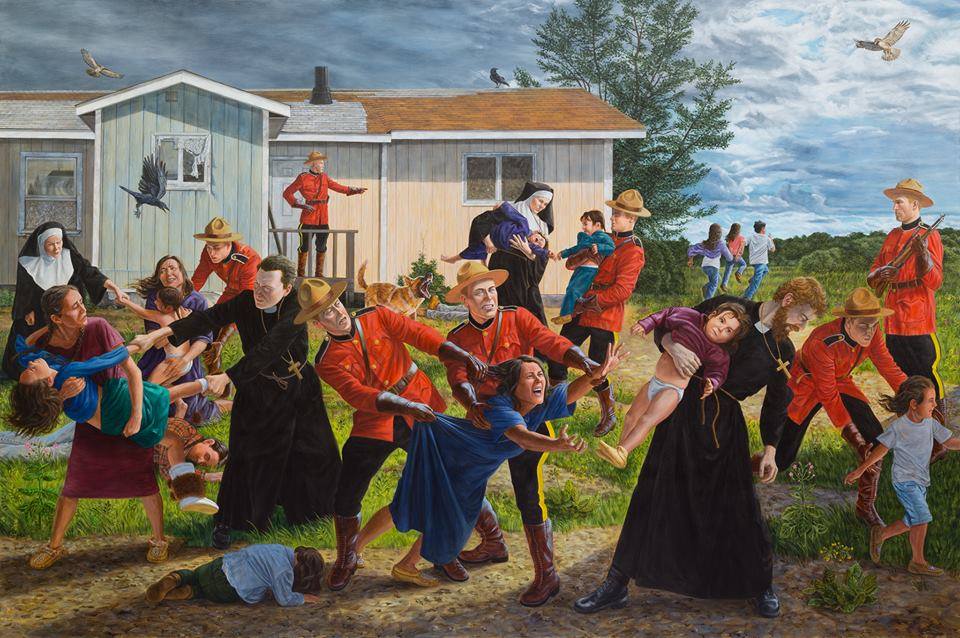
Painting by Kent Monkman of the tragic seizure of Indigenous children by the RCMP to place in mandatory boarding schools
Painting by Kent Monkman of the tragic seizure of Indigenous children by the RCMP to place in mandatory boarding schools. Pintrest

The tragic Death Wire in 1915
View of the Death Wire from the Dutch side in 1915. Netherlands National Archives

16. The Tragic Wire of Death

Early in 1915, the Germans erected an electric fence along a stretch of the Swiss border in order to isolate some Alsatian villages from Switzerland, and it proved effective. So they decided to replicate it on a grander scale, along the border between German-occupied Belgium, and the neutral Netherlands. Construction commenced in the spring of 1915 of an electric fence that stood five to ten feet high and covered over 125 miles of the Belgian-Dutch border from the Scheldt River to Aix-la-Chappelle. It was charged with 2,000 to 6,000 volt wires that ran through it.

The electrified Belgian-Dutch border in WWI brought many to a tragic end
The electrified Belgian-Dutch border in WWI brought many to a tragic end. Netherlands National Archives

Those caught within 100 to 550 yards of the fence who could not explain their presence were summarily shot. By war’s end, about 3,000 people had been killed along what came to be known as “The Wire of Death”, and newspapers in the southern Netherlands carried almost daily reports of unfortunates who had been “lightninged to death“. Nonetheless, while the fence reduced border crossings, it did not eliminate them. Many managed to cross the border with creative methods such as tunnels beneath the fence, the use of extra high ladders, pole vaulting over it, or tying porcelain plates to their shoes in order to insulate them.

Written by

A lifelong history buff, I developed a particular passion for WW2 history as a child, when I spent hours listening to my grandfather, enraptured, as he recounted his wartime experiences in the British East African Campaign and with the British 8th Army in North Africa.

I graduated with a history BA from George Mason University, then went on to get a JD from the University of Virginia School of Law. After lawyering for a decade, I moved to sunny Rio de Janeiro and a less demanding career, opening a tourism agency in Copacabana.

A big chunk of my free time is spent blogging (you can follow me on Quora https://www.quora.com/profile/Khalid-Elhassan ) or freelance writing, mostly about my favorite subject, history.

Keep reading

Advertisement