
Catastrophe and Aftermath
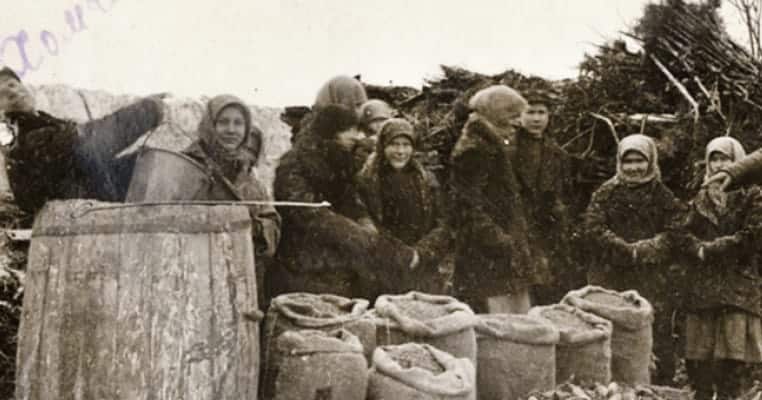
By early 1933, the Great Famine was in full swing, and thousands – most of them peasants in the countryside – were dropping dead every day, collapsing from starvation and its attendant consequences. However, the steadily growing catastrophe did not bring a halt to the forced collectivization, nor to the forced confiscation of grain and foodstuffs from peasants who had little to no surplus to spare. As news leaked of what was going on, Soviet authorities denied the catastrophe’s existence, labeled it fake news, and refused humanitarian assistance from the International Red Cross and other NGOs.
An information clampdown was ordered, and the Ukraine and southern Russia – the regions most impacted by the famine – were put under lockdown. Travel to and from the famine zones was restricted, trapping and condemning to death millions who might have survived had then been allowed to leave for parts of the USSR where food was more available. However, Stalin and his henchmen preferred the deaths of millions to the propaganda black eye that would result if so many eyewitnesses were allowed to spread their knowledge of the catastrophe taking place in the “workers’ paradise”.

The famine reached its peak in June of 1933, when an estimated 28,000 died of starvation each day – nearly 1200 every hour, or 20 every minute. Millions died of straightforward starvation, as their hungry bodies first consumed their fat reserves, then their muscles, before their lives were extinguished. Others fell to illnesses that their malnourished bodies were unable to resist. Yet more succumbed to waves of epidemic, such as typhus, that swept the Ukraine and southern Russia during the Great Famine. The final death toll is unknowable, but in the Ukraine, the tally ranges from a low of 3 million according to conservative modern estimates, to a high of ten million.
Today, the Great Famine is a bone of contention between the Ukraine and Russia. Kiev demands that the disaster be recognized as a deliberate genocide against the Ukrainian people, contending that industrialization was implemented despite the knowledge that it would lead to famine, and that Stalin had used famine as a weapon against the peasants. Moscow denies that the famine had been artificial, and contends that several other Soviet republics had endured starvation as well.

Depending on how one goes about defining “genocide”, a credible argument could be made for either position. Either way, however, there is no doubt that Stalin’s industrialization and forced collectivization policies set the stage for the Great Famine. Also undisputed is that Soviet actions after the catastrophe began, from confiscating foodstuffs from peasants who hardly had enough to feed themselves, to turning down international humanitarian aid, to preventing people in the starving regions from leaving, made things far worse.
_________________
Where Did We Find This Stuff? Some Sources and Further Reading
Redd, Wyatt – The Holodomor: Stalin’s Genocidal Famine that Starved Millions in the 1930s (2017)
Applebaum, Anne – Red Famine: Stalin’s War on Ukraine (2017)
Atlantic, The, October 13th, 2017 – How Stalin Hid Ukraine’s Famine From the World
Awesome Stories – Bitter Harvest: Story of the Holodomor
Encyclopedia Britannica – Ukraine, the Famine of 1932 – 1933
Holodomor Victims Memorial – The History of the Holodomor
New Republic, The, November 21st, 2017 – Why Stalin Starved the Ukraine


