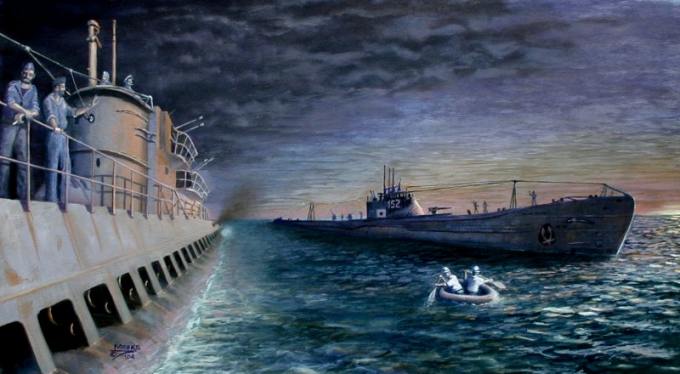
The Mission to Lorient

On March 10th, 1944, the I-52 left Kure naval base in Japan on her maiden mission. Captained by Commander Uno Kameo and crewed by 94 officers and men, the vessel had a long journey ahead of her, most of it through hostile waters. From the Sea of Japan, she was to head to the East China then South China seas. After a stop in Singapore, the I-52 was to cross the Bay of Bengal, traverse the Indian Ocean, round the Cape of Good Hope and enter the Atlantic. Then she would traverse most of the length of that ocean, before finally entering the Bay of Biscay and docking in the Nazi-controlled French port of Lorient. Her estimated date of arrival was June 6, 1944.
In her cargo hold, the I-52 carried 11 tons of tungsten, almost 10 tons of molybdenum, 3 tons of opium, and 54 kilograms of pure caffeine. She also carried 146 bars of gold, weighing 2.2 tons, intended as payment for German optical technology. In Singapore, she also picked up 3.3 tons of quinine, 60 tons of raw rubber, and 120 tons of tin. She also carried 14 passengers, mostly Japanese technicians, sent to study advanced German torpedo boat engine and antiaircraft gun technologies.
Awaiting the I-52 in Lorient, to carry back home to Japan, were about 40 tons of advanced Nazi technology, plus assorted secret documents, drawings, and schematics. The cargo for the return voyage included German radar equipment, vacuum tubes, optical glass, bombsights, chemicals, a Jumo 213-A engine used in the FW-190D fighter, and T5 acoustic torpedoes that could home in on the sound of ship propellers.

While docked, the I-52 was to also get fitted out with the latest in underwater technology: a snorkel. That device, a revolutionary advancement at the time, allowed submarines to operate underwater indefinitely while using their diesel engines (before, doing that underwater would have suffocated the crew), instead of relying solely on batteries of limited duration. The Japanese intended to reproduce the German snorkel when the I-52 got back, and to reequip their entire submarine fleet with the device.
More intriguingly, the cargo for the return trip included 1760 pounds of uranium oxide. That amount of unenriched uranium oxide would not have been enough for an atomic bomb – assuming the Japanese knew how to build one, which they did not. However, the Japanese could have used that material to create poisonous fission byproducts, that could have then been employed in radiological weapons like “dirty bombs”, for use against the US. Fortunately for the US, and unfortunately for the I-52, the Allies were tipped off about the Japanese submarine’s mission.


